
What this calculator models
This tool evaluates two separate questions under FinCEN’s November 17, 2026 Customer Due Diligence Notice of Proposed Rulemaking (Docket FINCEN-2026-0298, RIN 1506-AB78): first, how proposed edits to 31 CFR § 1010.230(b)(1)(ii)(D) treat your business ownership role if finalized; and second, what personal credit-building metrics remain under your direct control.
Entity CDD math vs. personal FICO® timing
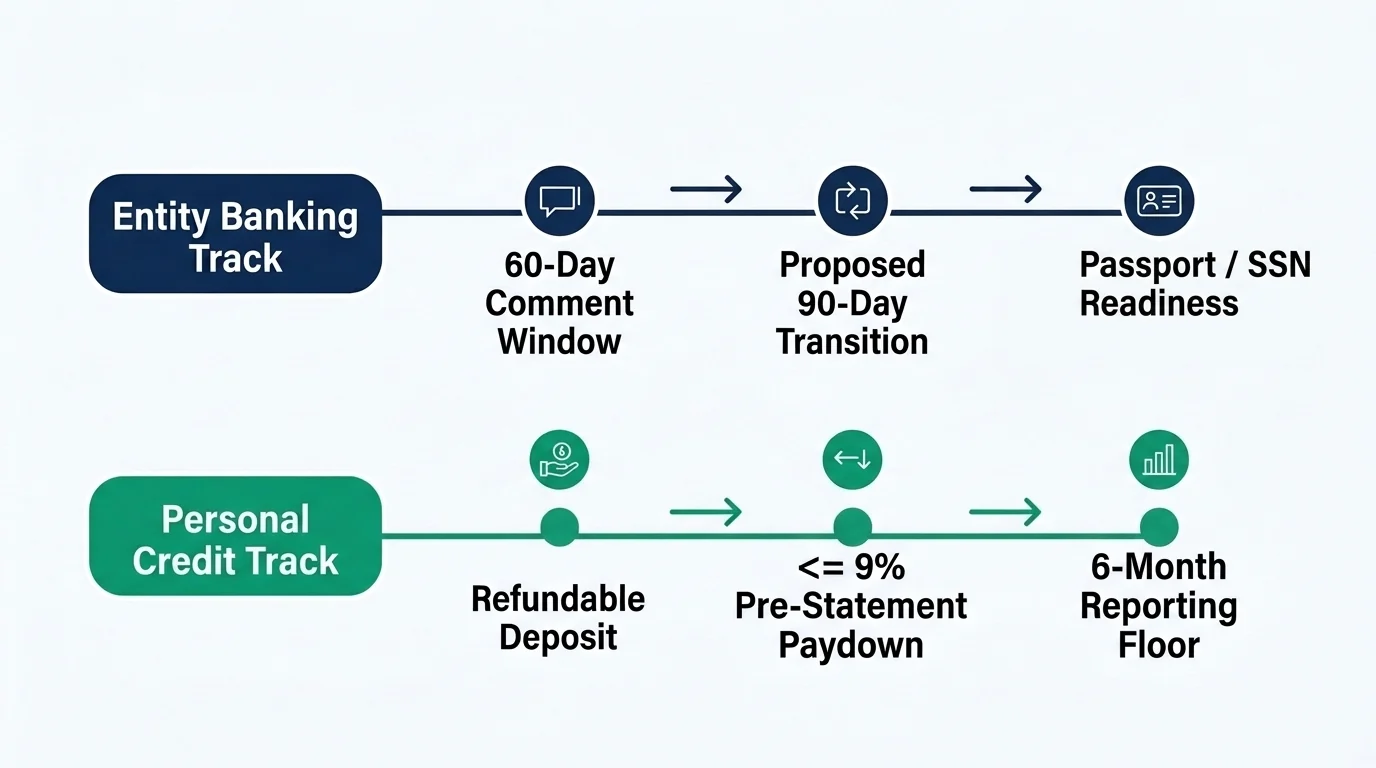
- Entity role: Beneficial owner rules apply to individuals holding 25% or more equity or significant control over a legal entity customer (LLC or corporation), not to unincorporated sole proprietors opening personal accounts.
- Proposed identifier distinction: Under proposed 31 CFR § 1010.230(b)(1)(ii)(D)(1), a U.S.-person beneficial owner must provide an SSN (excluding an ITIN), while proposed § 1010.230(b)(1)(ii)(D)(2) allows a non-U.S. person to supply a valid passport number and country of issuance, alien ID card number, or qualifying government photo ID.
- Personal credit path: Consumer credit reports under your ITIN at Equifax, Experian, and TransUnion remain governed by the Fair Credit Reporting Act and individual CIP rules. Keeping reported statement balances at or below 9% of a refundable secured deposit helps manage utilization while you satisfy the 6-month minimum active history window for a FICO® Score.
What the estimate cannot tell you
This calculator cannot predict whether FinCEN will modify its final rule after the 60-day comment period, whether a bank will apply discretionary risk-based enhanced due diligence under proposed § 1010.230(b)(1)(ii)(E), or what exact credit score any bureau model will produce. Confirm all entity banking rules with your bank and consult qualified U.S. counsel when forming or banking an LLC.
Comparing Entity CDD Preparation Against Personal Credit Milestones
Business founders frequently conflate business-bank compliance updates with their personal U.S. credit profile. Keeping both tracks separated clarifies which steps depend on FinCEN rulemaking versus what you control immediately:
| Planning Dimension | Entity Banking Track (LLC / Corp — Proposed CDD) | Personal Consumer Track (ITIN Credit Building) |
|---|---|---|
| Triggering Threshold | 25% or more direct/indirect equity ownership or 1 control manager on a state-registered entity account. | Individual consumer application in your personal legal name with a U.S. residential street address. |
| Accepted Documentation | Under proposed § 1010.230(b)(1)(ii)(D), non-U.S. persons use foreign passport + country of issuance; U.S. persons would require an SSN. Repeat entity openings at the same institution codify Order FIN-2026-R001 relief. | IRS Notice CP565 ITIN + unexpired passport + U.S. checking account (e.g., in-branch Bank of America checking or online ITIN card applications where offered). |
| Discretionary Checks | Proposed § 1010.230(b)(1)(ii)(E) permits additional inquiries (including lawful status and work authorization) when triggered by risk indicators. | Standard Truth in Lending (TILA) income, housing payment, and Fair Credit Reporting Act identity matching at Equifax, Experian, and TransUnion. |
| Key Numeric Target | 60-day NPRM comment window + proposed 90-day transition after any final rule in the Federal Register. | Keep reported statement balance at ≤ 9% of credit limit and allow at least 6 months of active reporting for a FICO® Score. |
Five Limitations & Compliance Boundaries of This Estimator
- Proposed Text May Change After Comment Review: Docket FINCEN-2026-0298 is a Notice of Proposed Rulemaking as of November 18, 2026; banks, trade groups, and advocacy comments may prompt revisions before any final rule takes effect.
- Living Outside the U.S. Still Blocks Most Consumer Cards: Receiving an ITIN letter (CP565) from abroad does not satisfy physical U.S. street address and identity rules required by major issuers like Chase, Capital One, Citi, American Express, and Wells Fargo.
- FICO® Score Timeline Requires Ongoing Statement Activity: Paying down below 9% utilization controls reported balances, yet myFICO scoring rules still require at least one tradeline open and reported within the past 6 months.
- Unverified Card Discover Form Support Excluded: This tool does not assume universal online ITIN acceptance across issuers whose product pages omit public ITIN policies.
- Verify Legal Structure With Qualified Professionals: Decisions to convert, restructure, or bank an LLC or corporation under 31 CFR § 1010.230 require individualized review by a licensed business attorney or CPA.
Frequently Asked Questions About LLC Ownership and ITIN Credit Files
If FinCEN finalizes this rule, does my existing personal ITIN bank account close automatically?
No. Proposed 31 CFR § 1010.230(b)(1)(ii)(D) applies only to beneficial-owner identity verification for legal entity customers such as corporations and LLCs. Personal depository checking accounts and personal consumer credit cards remain governed by Customer Identification Program rules under 31 CFR § 1020.220, which continue to list non-U.S. taxpayer identification numbers and foreign passports as permitted customer identifiers.
Related Guides
- U.S. Account, Card & Loan Document Checker (FinCEN & CIP Rules)
- FinCEN’s Nov 17 ITIN Proposal Explained: Personal Accounts vs. Business Owners
- Credit Card After Receiving Your ITIN (2026): Issuer Rules and How to Apply
Sources checked November 18, 2026
- U.S. Department of the Treasury: Treasury Press Release sb0691 (November 17, 2026)
- FinCEN: Customer Due Diligence NPRM (31 CFR § 1010.230)
- CFPB: Credit card and credit report guidance