

Short answer: Receiving your IRS Notice CP565 ITIN letter lets you apply for select U.S. credit cards without a Social Security Number—most reliably starting with a $0-annual-fee secured card or student card from an issuer whose application field explicitly accepts an ITIN. However, an ITIN alone generally does not let you obtain a mainstream U.S. consumer card while living outside the United States: major U.S. issuers require a physical U.S. residential street address (not a P.O. Box), and some banks require an in-person branch visit for first-time non-SSN identity checks.
New ITIN holders often ask the same practical question right after opening their IRS envelope: which U.S. banks still accept an ITIN on a credit card application, and can you complete everything remotely from abroad? Because issuers routinely adjust online forms—and because federal rules draw a sharp line between personal credit cards and business entity banking—knowing exact 2026 issuer policies saves you from wasted hard inquiries.
Can you get a U.S. credit card with an ITIN without visiting the United States?
For mainstream U.S. consumer credit cards, usually no if you lack a physical U.S. street residence. Official application basics published by Chase, Citi, and Wells Fargo state that applicants need a physical U.S. residential street address rather than a P.O. Box, alongside verifiable income and a U.S. tax number. Commercial mail-forwarding boxes frequently fail electronic Customer Identification Program (CIP) address checks.
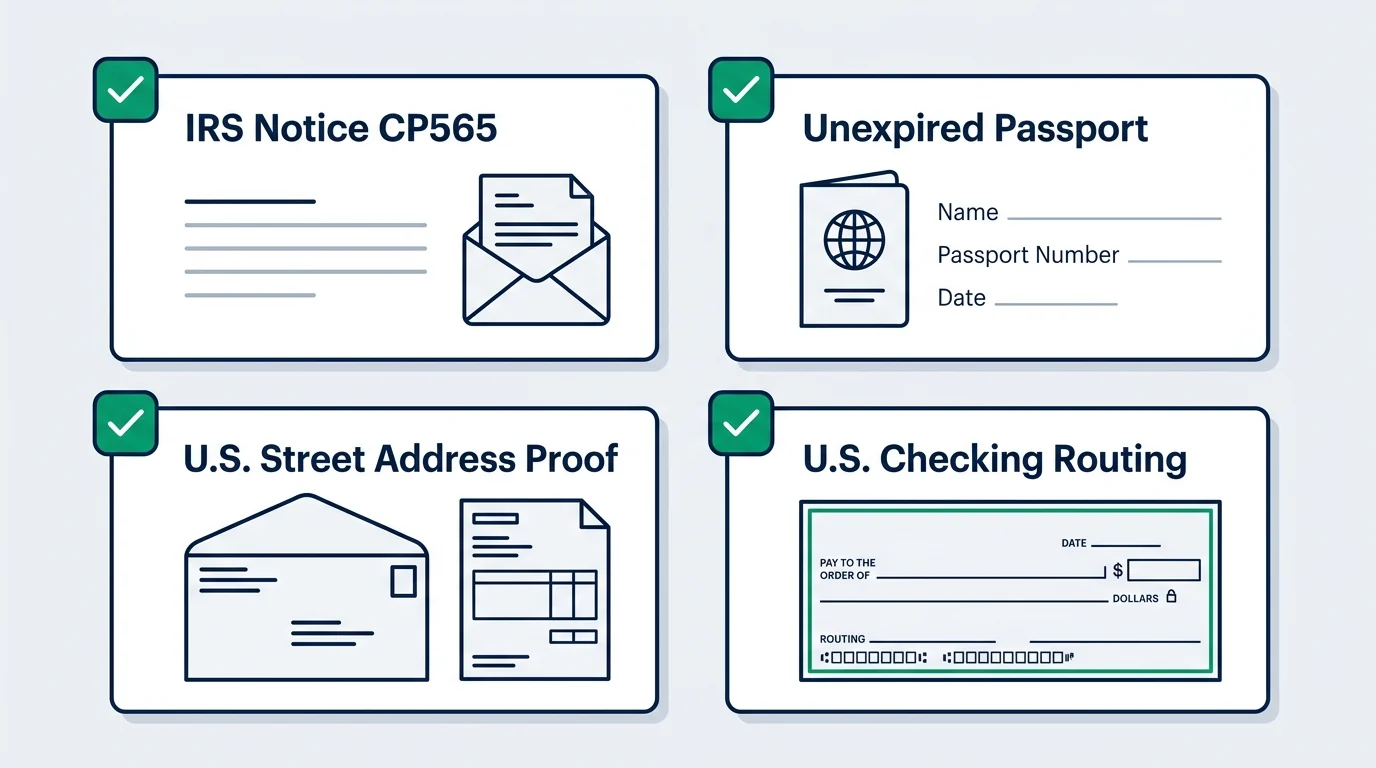
Wait until you have both your IRS Notice CP565 and a verifiable U.S. street address (such as a signed apartment lease or utility bill) plus an active U.S. checking account to fund a refundable security deposit and autopay.
Which U.S. card issuers accept an ITIN in November 2026
Unlike marketing roundups that copy outdated bank lists, the table below separates what each major issuer explicitly publishes on its own site from what remains unconfirmed in public product disclosures as of November 18, 2026.
| Card issuer | Published 2026 ITIN policy | Channel & key caveats | Verification status |
|---|---|---|---|
| Capital One | Official ITIN credit card guide (April 30, 2026) and immigrant guide confirm you may apply for select cards with an ITIN, including secured options like Platinum Secured. | Online application and pre-approval tool; may request passport and address upload if automated matching stalls. | Confirmed on issuer domain |
| American Express | Official Credit Intel guide confirms ITIN eligibility, plus Nova Credit (select countries) and Global Card Transfer. Since August 28, 2023, an SSN or ITIN is mandatory (the no-ID waiver ended). | Online application; requires physical U.S. address, U.S. phone, and meeting issuer income/credit standards. | Confirmed (Amex + policy record) |
| Chase | Official application-basics and international student guides state applicants must be 18+, have a physical U.S. street address, and enter an SSN or ITIN. | Individual card landing pages (such as Freedom Rise) do not print ITIN instructions; branch verification or checking history often matters for thin files. | Confirmed in general guides; verify product form |
| Citi | Official card requirements page explicitly lists “Social Security number (SSN) or Individual Taxpayer Identification Number (ITIN).” | The Citi Secured Mastercard landing page omits ITIN copy; confirm the live application form displays the SSN/ITIN field before submitting. | Confirmed in general guides; check product form |
| Wells Fargo | Official New-to-the-U.S. credit guide states an SSN or ITIN is accepted to open bank accounts and apply for credit. | Consumer card landing pages do not publish card-by-card ITIN tables; non-SSN applicants often complete verification at a branch. | Confirmed in general guide; branch fallback common |
| Bank of America | Official deposit FAQs confirm ITIN acceptance in-branch for checking/savings, while card product pages omit public ITIN wording. | Credit card ITIN acceptance is reported by applicants in financial centers or by phone, not published on consumer card landing pages. | Deposits confirmed; cards unconfirmed publicly (ask in branch) |
| Discover | Discover’s immigrant education page could not be verified directly on November 18, 2026 (HTTP 503), and consumer reports note standard online forms historically prompt for an SSN. | Do not apply blindly with an ITIN unless the live form or customer service explicitly accepts it for that card. | Unconfirmed / mixed reports |
Note also how FinCEN’s November 17, 2026 proposed beneficial-ownership rule affects business LLC accounts, not personal consumer cards. You can check your exact product and ID match in our U.S. Account, Card & Loan Document Checker.
Compare Starter & Secured Credit Cards Before You Apply
Check refundable security deposit minimums, $0 annual fee options, and tri-bureau reporting details side by side—then confirm on the issuer's live form that your ITIN is accepted before taking a hard inquiry.
Compare Starter Credit Cards →What to prepare after receiving IRS Notice CP565
Even with an ITIN-friendly issuer, automated Know Your Customer checks often pause when an ITIN has no prior U.S. credit file. Prepare a consistent packet before you open a single application:
- Your IRS Notice CP565 (not a plastic card): The IRS issues ITINs on paper notice CP565 (or letter 147C if replaced). Keep a clear PDF and physical copy ready in case underwriting requests verification.
- Unexpired government photo ID: A valid foreign passport is the most widely accepted primary ID across bank branches and secondary card verification queues.
- Character-for-character name and street address consistency: Credit bureaus (Equifax, Experian, TransUnion) match ITIN tradelines using your full legal name, date of birth, U.S. street address, and 9-digit ITIN. Switching compound surnames or abbreviations splits your bureau history.
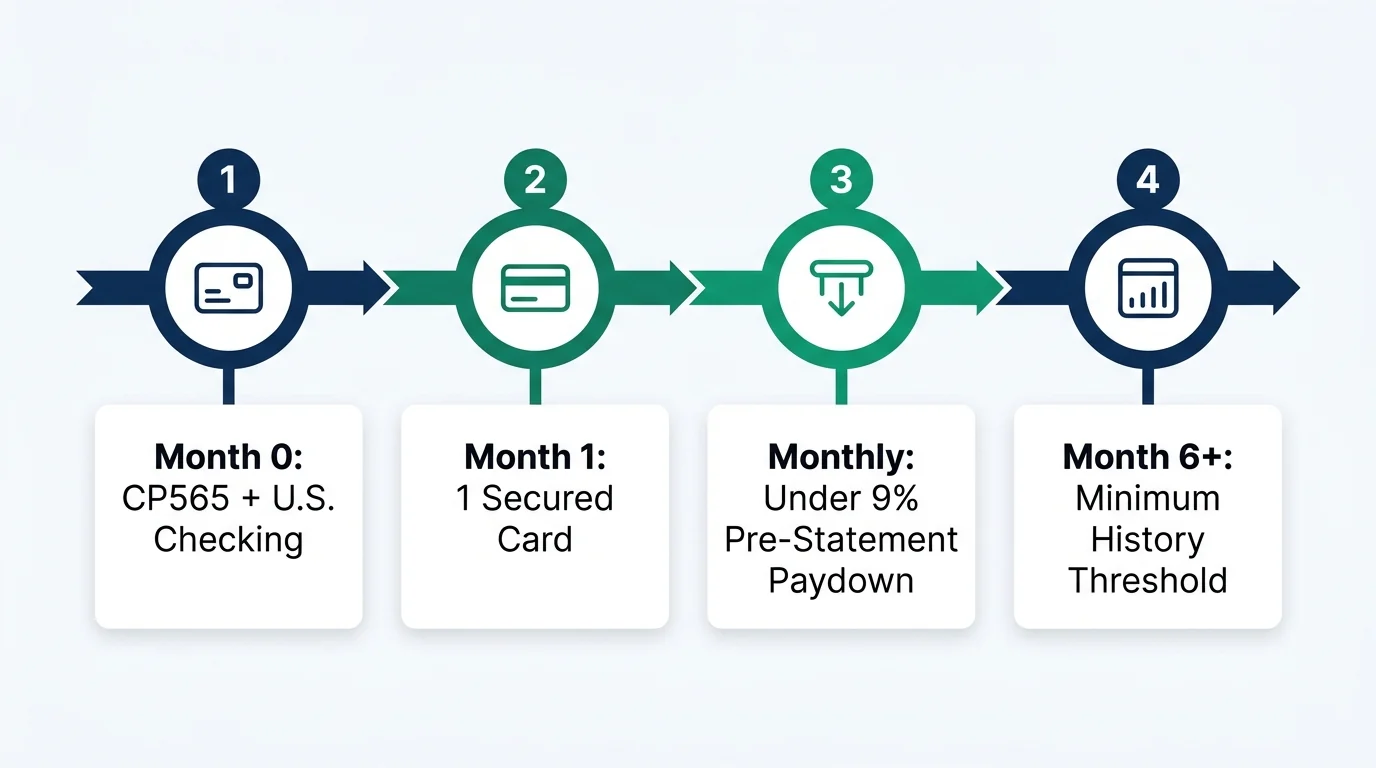
- A funded U.S. checking account: You need a U.S. bank routing and account number to post a refundable secured deposit (typically $49 to $200+ depending on card tier) and enable monthly autopay. If you have not opened checking yet, review our No-SSN Banking Matrix.
- Verifiable annual income and housing payment: Under the Credit CARD Act of 2009, applicants under age 21 must show independent income or a co-signer, and all applicants report gross income and monthly rent/housing cost.
First-card strategy: secured cards vs. international transfer paths
If your U.S. credit file is completely blank, applying for three unsecured travel cards in one weekend adds hard inquiries without creating a tradeline. Start with one high-fit path:
- $0-annual-fee secured card: You place a refundable deposit that typically secures a $200–$500 initial limit. That deposit is collateral, not a payment toward monthly charges. Keep one small recurring bill on the card, pay the statement down below 9% of the limit two to three days before the statement closing date, and pay the full statement balance by the due date to avoid purchase APR interest.
- International credit transfer or global banking history: If you hold an established American Express card from an eligible country or have an existing deposit relationship at a major branch bank, inquire about Global Card Transfer or branch relationship starter cards before opening a secured line.
- Avoid fee-harvester subprime cards and CPN scams: Walk away from any card charging high upfront application fees, monthly program fees, or zero grace periods, and never enter a purchased “CPN” number in place of an IRS ITIN or SSA SSN.
According to myFICO, generating a FICO® Score requires at least one account open for six months or more and reported to the bureaus within the past six months. Model exact pre-statement paydowns with our Credit Utilization Calculator and read our ITIN vs. SSN credit-building timeline for how to migrate accounts when an SSN arrives later.
Frequently asked questions
Can I apply for a credit card the same day I receive my IRS CP565 notice?
Yes, as long as you already have a physical U.S. street address, verifiable income, and a U.S. checking account ready to fund any security deposit or autopay. Confirm that the issuer application explicitly accepts an ITIN.
Which major banks definitely accept an ITIN on credit card applications?
Capital One and American Express publish official guidance confirming ITIN acceptance on consumer card applications, and Chase, Citi, and Wells Fargo state in general application guides that either an SSN or ITIN is accepted—though individual card pages often omit ITIN instructions and branch or document verification may be required.
Will my credit score start lower because I used an ITIN instead of an SSN?
No. Scoring formulas evaluate payment history, utilization, credit age, and inquiries in your bureau file, not whether the identifier is an ITIN or an SSN. Expect roughly six months of active reporting before a FICO® Score generates.
What happens if my ITIN expires?
Under IRS renewal rules, an ITIN expires if not used on a federal tax return for three consecutive tax years. Renew via Form W-7 before applying for new financial products so tax-ID checks do not stall.
Sources checked November 18, 2026
- Capital One: How To Get a Credit Card With an ITIN (April 30, 2026) and Credit cards for immigrants
- American Express: How to Get a Credit Card Without an SSN and NerdWallet: AmEx ends zero-SSN/zero-ITIN card exception
- Chase: Everything to know when applying for a credit card online
- Citi: Requirements for a credit card
- Wells Fargo: How to build credit when new to the U.S.
- Bank of America: Applying for deposit accounts FAQs
- IRS: Understanding your CP565 notice and How to renew an ITIN