
How to use this document & FinCEN rule checker
Choose the U.S. account, credit card, or loan you want to open, along with your current taxpayer identification number, primary photo ID, residential address setup, entity role, and preferred channel. The tool separates personal Customer Identification Program (CIP) rules under 31 CFR § 1020.220 from FinCEN’s November 17, 2026 Notice of Proposed Rulemaking (Treasury Press Release sb0691) covering beneficial owners of legal entity customers under 31 CFR § 1010.230.
Why personal accounts and entity accounts follow different federal rules
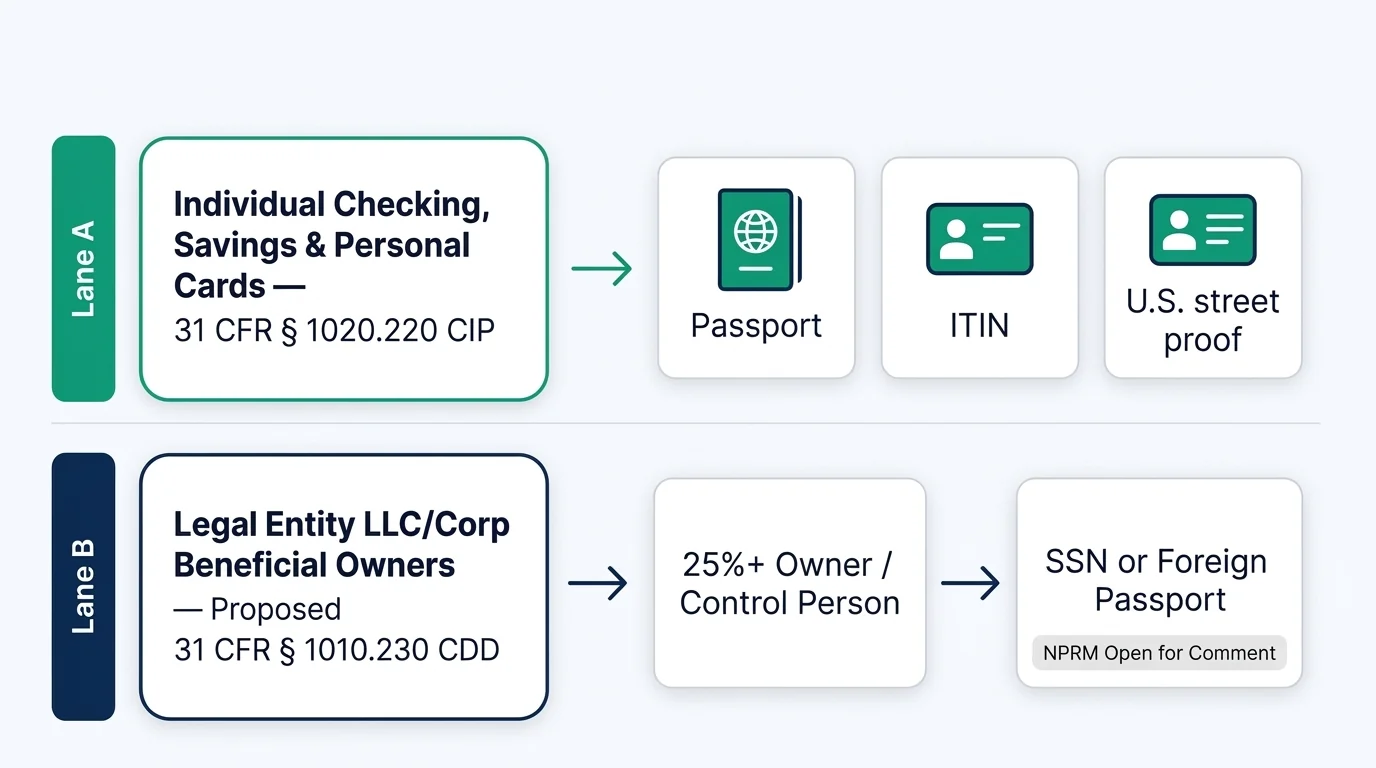
In the November 17, 2026 proposed rule (CDD-NPRM-11122026.pdf), FinCEN proposes barring banks from accepting an Individual Taxpayer Identification Number (ITIN) as a substitute for a Social Security Number (SSN) when identifying and verifying the 25% equity owners and control person of a legal entity customer such as an LLC or corporation. The same proposal explicitly states that CIP rules in 31 CFR § 1020.220(a)(2)(i) still allow an ITIN or foreign passport for individual customers and should not be conflated with the corporate CDD proposal.
What this checker cannot verify for you
- This tool does not read live bank underwriting tables, pull credit reports, or override individual issuer channel restrictions.
- Major U.S. banks and card issuers still require a physical U.S. residential street address (not a P.O. Box or mail forwarder) and can request an in-person branch visit for non-SSN verification.
- FinCEN Docket FINCEN-2026-0298 is a proposed rule open for a 60-day public comment period after Federal Register publication, with a proposed effective window 90 days after any final rule is published.
Document Matrix: Personal CIP vs. Legal-Entity CDD Requirements
Before visiting a financial center or uploading documents online, separate personal banking rules under 31 CFR § 1020.220 from FinCEN’s November 17, 2026 proposed beneficial-ownership changes under 31 CFR § 1010.230:
| Product or Account Type | Federal Identification Framework | Accepted Tax ID & Photo ID Rules | Key Practical Constraint |
|---|---|---|---|
| Personal Checking, Savings & Consumer Credit Card | Existing Customer Identification Program (CIP — 31 CFR § 1020.220) | Allows SSN or non-U.S. taxpayer identification number (including IRS Notice CP565 ITIN) plus unexpired foreign passport or gov ID. | Issuers require a physical U.S. street address (not a P.O. Box) and may require in-branch identity review. |
| Sole Proprietorship (Unincorporated / Schedule C) | Individual / Commercial CIP (not a statutory legal entity customer) | Evaluated under individual CIP and bank business underwriting rather than 25%+ equity beneficial-owner forms. | Individual banks still set proprietary DBA, licensing, and local branch rules independently. |
| LLC or Corporation — Non-U.S. Beneficial Owner (25%+) | Proposed 31 CFR § 1010.230(b)(1)(ii)(D)(2) | Proposed rule drops ITIN substitution, while explicitly permitting valid foreign passport number + country of issuance, alien ID card, or qualifying gov photo ID. | Banks may still apply enhanced risk-based due diligence under proposed § 1010.230(b)(1)(ii)(E). |
| LLC or Corporation — U.S.-Person Beneficial Owner (25%+) | Proposed 31 CFR § 1010.230(b)(1)(ii)(D)(1) | Proposed text specifies a Social Security Number and explicitly excludes substituting an ITIN. | Comment Question 7 seeks input on lawfully present U.S. individuals who hold an ITIN without another listed ID. |
Step-by-Step Preparation Before Applying
- Keep personal and entity packets separate: Bring your IRS Notice CP565, unexpired passport, and residential lease or utility bill for personal accounts rather than mixing LLC operating agreements into consumer applications.
- Verify the live product application field: Major banks such as Capital One, American Express, Chase, Citi, and Wells Fargo reference ITIN acceptance in general guidance, yet specific card landing pages do not always mirror every general FAQ—confirm the tax ID field live or ask in a financial center.
- Watch the Federal Register publication clock: Docket
FINCEN-2026-0298carries a 60-day public comment period once printed in the Federal Register and proposes a 90-day implementation window only after any final rule is issued.
Why FinCEN Issued Docket FINCEN-2026-0298 and What It Covers
Issued on November 17, 2026 under Executive Order 14406 (May 19, 2026, 91 FR 30479), the FinCEN Notice of Proposed Rulemaking (31 CFR § 1010.230) updates beneficial-ownership Customer Due Diligence standards across covered banks, brokers, mutual funds, and futures commission merchants. It defines covered beneficial owners strictly as natural persons owning 25% or more equity interests or exercising substantial managerial control in a legal entity customer, while codifying FinCEN Order FIN-2026-R001 so repeat account openings at the same institution do not require re-submitting identical ownership forms unless risk indicators arise.
Related guides
- FinCEN’s Nov 17 ITIN Proposal Explained: Personal Accounts vs. Business Owners
- U.S. Bank Account Opening Matrix Without an SSN
- Credit Card After Receiving Your ITIN (2026): Issuer Rules and How to Apply
Sources checked November 18, 2026
- U.S. Department of the Treasury: FinCEN Issues Proposed Rule to Strengthen Customer Due Diligence Requirements (sb0691)
- FinCEN Notice of Proposed Rulemaking: 31 CFR § 1010.230 CDD NPRM (Docket FINCEN-2026-0298, RIN 1506-AB78)
- IRS: Individual Taxpayer Identification Number (ITIN) overview