
Short answer: On November 17, 2026, the U.S. Treasury’s Financial Crimes Enforcement Network (FinCEN) issued a proposed rule—not an enacted ban—that would bar banks from accepting an Individual Taxpayer Identification Number (ITIN) instead of a Social Security Number (SSN) when verifying beneficial owners of legal entity customers such as LLCs and corporations (31 CFR § 1010.230). Personal consumer checking accounts and personal ITIN credit cards remain governed by separate Customer Identification Program rules (31 CFR § 1020.220), and the proposal still enters a 60-day public comment period after Federal Register publication.
Posts circulating across social media after the November 17, 2026 Treasury announcement claim that U.S. banks can no longer open accounts with an ITIN. Reading the actual text of Docket FINCEN-2026-0298 (RIN 1506-AB78) tells a much more specific story. The proposal targets business entity due diligence and risk indicators, not routine individual consumer banking.
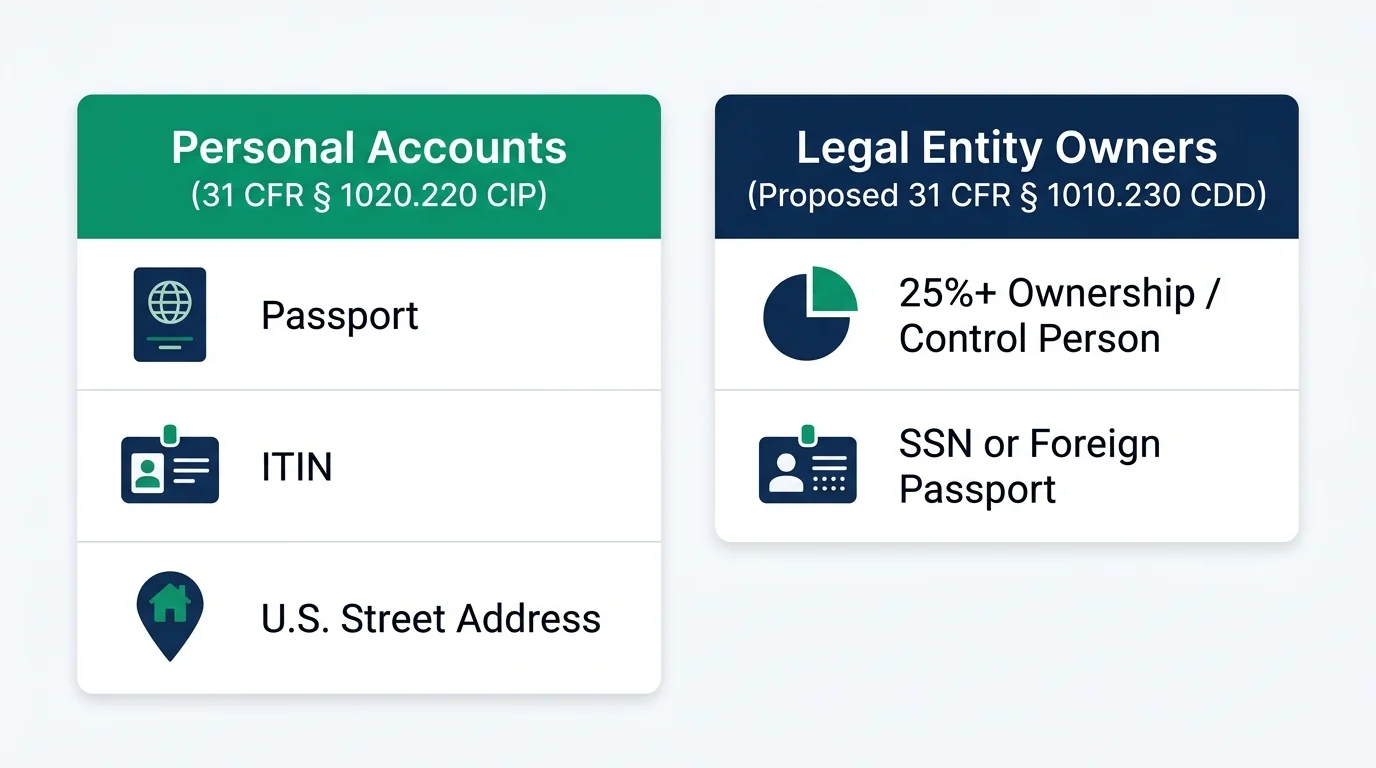
Two federal rules people confuse: CIP vs. proposed CDD
U.S. federal banking regulations split identity verification into two separate obligations depending on who opens the account:
- Customer Identification Program (CIP — 31 CFR § 1020.220): Governs individual consumers opening personal checking, savings, or credit card accounts, as well as direct corporate entities. For a non-U.S. person, § 1020.220(a)(2)(i)(A)(4)(ii) still explicitly permits a bank to collect a taxpayer identification number (including an ITIN), a passport number and country of issuance, an alien identification card number, or another government-issued photo ID.
- Customer Due Diligence Beneficial Ownership Rule (CDD — 31 CFR § 1010.230): Governs covered financial institutions (banks, broker-dealers, mutual funds, and futures commission merchants) when a legal entity customer—such as an LLC, corporation, or limited partnership—opens an account. Covered institutions must identify each natural person who owns 25% or more of equity interests plus one control person.
Section IV of FinCEN’s November 17, 2026 Notice of Proposed Rulemaking explicitly addresses this overlap. FinCEN notes that CIP rules specifically permit an ITIN for non-U.S. persons and clarifies that the proposed ban on ITIN substitution under the CDD Rule applies to beneficial owner verification for legal entities and should not be misread as rewriting CIP identification categories for individual consumers.
What the November 17, 2026 FinCEN proposal actually changes
Issued to implement Section 3(b) of Executive Order 14406 (May 19, 2026, 91 FR 30479), Docket FINCEN-2026-0298 proposes four concrete revisions to 31 CFR § 1010.230:
| Provision in 31 CFR § 1010.230 | Proposed rule language | Who is affected if finalized |
|---|---|---|
| U.S.-person beneficial owners — § 1010.230(b)(1)(ii)(D)(1) | Requires a Social Security Number and explicitly states “(not including an Individual Taxpayer Identification Number)”. | Individuals treated as U.S. persons who own 25%+ or control an LLC or corporation but lack an SSN. |
| Non-U.S.-person beneficial owners — § 1010.230(b)(1)(ii)(D)(2) | Permits an SSN (not including an ITIN), passport number and country of issuance, alien ID card number, or qualifying government photo ID. | Foreign founders or non-U.S. entity owners: ITIN alone would no longer qualify, so a valid foreign passport or listed ID is required. |
| Risk-based status inquiries — § 1010.230(b)(1)(ii)(E) | Clarifies banks may obtain additional information—including lawful immigration status and U.S. work authorization—where warranted by risk indicators or supervisory concerns. | Legal entity beneficial owners whose onboarding triggers fraud, identity misrepresentation, or sanctions risk flags. |
| Repeat account-opening relief — § 1010.230(b)(1)(i) & (iv)(B) | Codifies FinCEN Order FIN-2026-R001: banks no longer need fresh BOI every time an existing entity customer opens another account, unless reliability is questioned. | Existing LLCs and corporations opening multiple accounts at the same financial institution. |
Check whether your specific goal triggers personal CIP rules or the proposed business entity rule with our interactive U.S. Account, Card & Loan Document Checker.
Personal checking, credit cards, and ITIN credit files today
If you hold an IRS-issued ITIN (Notice CP565) solely to manage personal household finances, pay U.S. taxes, open a personal checking account, or build an individual credit report, this November 17 proposal does not revoke your personal bank account or force closure of existing personal credit cards.
Two separate practical limits still matter far more for individual ITIN holders today:
- Physical U.S. address and branch policies: Automated online account portals often reject applicants who lack an SSN because identity-matching vendors look up U.S. bureau files. Large branch banks—including Bank of America’s financial center deposit process—continue to require in-person verification with a foreign passport, proof of U.S. street address, and Form W-8BEN or CP565. Review our No-SSN Banking Matrix before visiting a branch.
- Issuer-specific card application forms: Card issuers decide individually whether their application accepts an ITIN field, what deposit a secured card requires, and whether branch verification is needed. Compare current published policies in our updated credit card guide for ITIN applicants without an SSN.
Compare Personal Credit Cards Built for New U.S. Files
Keep personal credit building separate from business entity filings. Review secured and starter card disclosures, security deposit minimums, and reporting practices before applying (TILA terms and issuer approval rules apply).
Compare Starter & Secured Credit Cards →How LLC and corporate founders with an ITIN would verify identity
Suppose you formed a single-member or multi-member LLC using an Employer Identification Number (EIN) and hold an ITIN instead of an SSN. Under existing FinCEN exceptive relief and current CDD rules, some banks previously accepted an ITIN on Appendix A certification forms. Under the proposed November 17 text, what happens next depends on your classification:
- If you are a non-U.S. person with a valid foreign passport: Proposed § 1010.230(b)(1)(ii)(D)(2)(ii) specifically lists a valid passport number and country of issuance as an acceptable identifier for a non-U.S. beneficial owner. Your ITIN alone would no longer substitute for an SSN, so keeping an unexpired passport and foreign/U.S. address records aligned becomes essential.
- If you are treated as a U.S. person without an SSN: Proposed § 1010.230(b)(1)(ii)(D)(1) requires a Social Security Number and removes the ITIN substitution option. FinCEN explicitly asks in Comment Question 7 whether lawfully present individuals can hold an ITIN without any other listed qualifying document.
- If you work as an unincorporated sole proprietor: A sole proprietorship without a separate state-filed LLC or corporation is not a “legal entity customer” under 31 CFR § 1010.230, though banks still conduct individual CIP checks and commercial account underwriting.
You can model both business compliance readiness and your personal credit-building timeline side by side in the Beneficial-Owner ITIN vs. SSN Impact Calculator.
Discretionary immigration status questions and risk indicators
Another widely shared headline involves whether banks must check immigration status. Proposed § 1010.230(b)(1)(ii)(E) does not establish mandatory immigration screening on every bank customer. Instead, it states that where warranted by risk indicators or supervisory concerns—such as suspected fraud, identity misrepresentation, sanctions evasion, or other illicit financial activity—a covered financial institution may request additional information, including lawful immigration status and employment authorization in the United States.
In addition, remember that separate federal guidance shifted earlier in 2026: in January 2026, the CFPB and Department of Justice withdrew their 2023 joint statement on immigration status and fair lending, giving private lenders wider latitude in evaluating residency duration and documentation risk independently of FinCEN’s BSA rules.
Rulemaking timeline: 60-day comment period and 90-day effective window
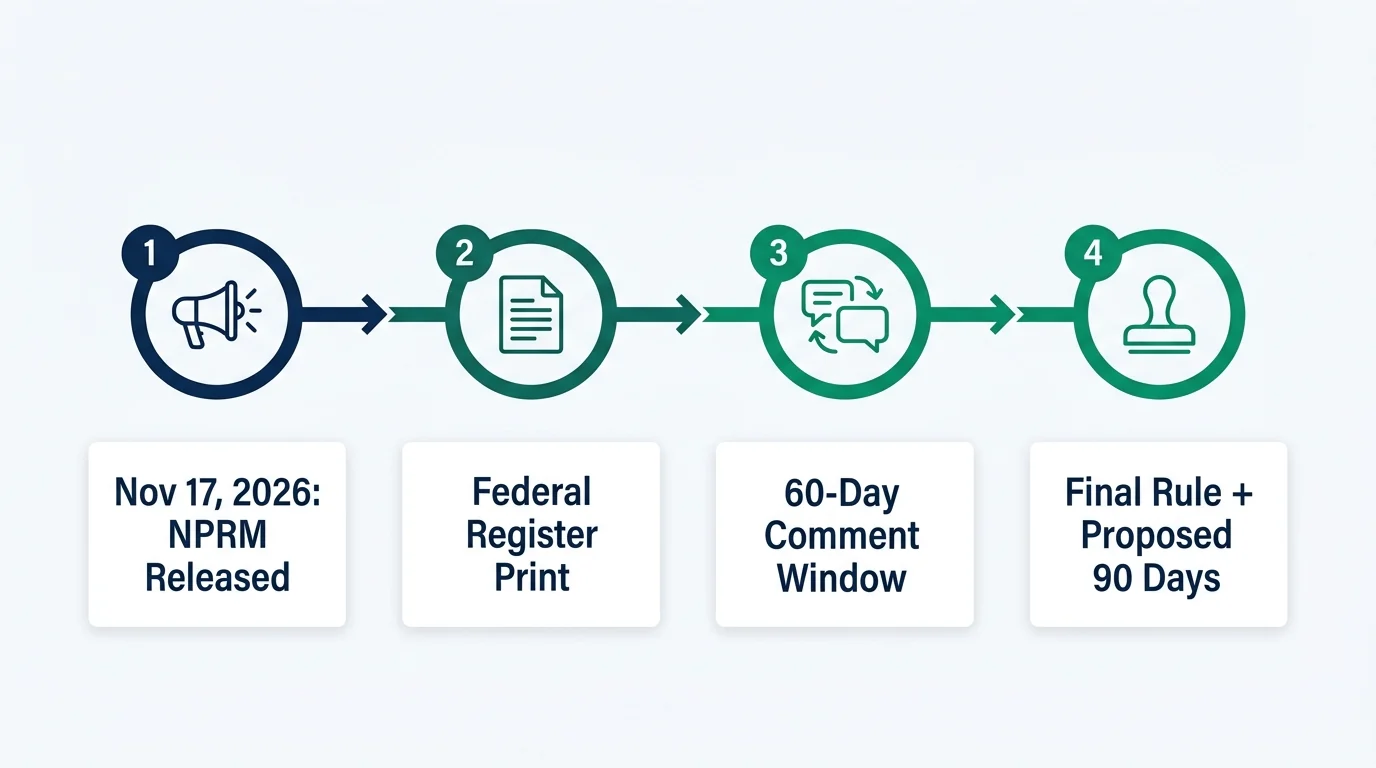
As of November 18, 2026, nothing in Docket FINCEN-2026-0298 has legal force yet. Under federal administrative procedure, FinCEN’s proposed rule must pass through three steps before binding banks:
- Federal Register publication of the NPRM: FinCEN submitted the signed document (
CDD-NPRM-11122026.pdf) for Federal Register publication with a placeholder deadline 60 days after Federal Register print. - Public comment window (60 days): Individuals, small business groups, banks, and legal advocates may submit comments under Docket
FINCEN-2026-0298on Regulations.gov. - Final rule & effective date: FinCEN must review public comments and publish a final rule. Even then, Section V of the NPRM proposes an effective date 90 days after publication of the final rule in the Federal Register.
Practical checklist while the proposal is open for comment
- Separate personal and LLC banking: Keep personal checking and consumer credit cards in your individual name rather than running personal credit-building activity through a business LLC account.
- Keep IRS CP565 and passport synchronized: Ensure your legal name, date of birth, and current U.S. street address match across your IRS ITIN letter, unexpired passport, and bank records.
- Watch ITIN expiration rules: An ITIN expires if unused on a federal tax return for three consecutive tax years; keep tax filings current or renew via Form W-7.
- Consult qualified counsel for entity structures: If your LLC relies on a beneficial owner who has an ITIN without an SSN or foreign passport, track the
FINCEN-2026-0298docket and review banking contingency plans with a qualified attorney or CPA.
Frequently asked questions
Does the November 17, 2026 FinCEN rule ban me from keeping my personal ITIN bank account?
No. The November 17, 2026 document is a proposed rule targeting beneficial-ownership verification for legal entity customers under 31 CFR § 1010.230. Individual accounts remain covered by CIP rules (31 CFR § 1020.220), which still allow ITINs and foreign passports.
Can a non-U.S. LLC owner still verify identity if FinCEN removes ITINs from the CDD Rule?
Under the proposed regulatory text in § 1010.230(b)(1)(ii)(D)(2), a non-U.S. person beneficial owner may use a valid passport number and country of issuance, alien ID card number, or qualifying government photo ID, though individual banks set their own risk onboarding standards.
When does the proposed ITIN restriction take effect?
It has no effective date yet. A 60-day comment period starts once the proposal prints in the Federal Register, and FinCEN proposes making any final rule effective 90 days after the final rule is published.
Will this proposal affect my FICO® Score or existing consumer credit cards?
No. Consumer credit bureau files at Equifax, Experian, and TransUnion are governed by individual reporting agreements and the Fair Credit Reporting Act, not business CDD rules.
Sources checked November 18, 2026
- U.S. Department of the Treasury: FinCEN Issues Proposed Rule to Strengthen Customer Due Diligence Requirements (sb0691, November 17, 2026)
- FinCEN Notice of Proposed Rulemaking: Customer Due Diligence Requirements for Covered Financial Institutions (31 CFR § 1010.230, Docket FINCEN-2026-0298, RIN 1506-AB78)
- FinCEN Exceptive Relief Order: FIN-2026-R001 (February 13, 2026)
- Internal Revenue Service: Individual Taxpayer Identification Number (ITIN)
- eCFR: 31 CFR § 1020.220 Customer Identification Program requirements for banks