
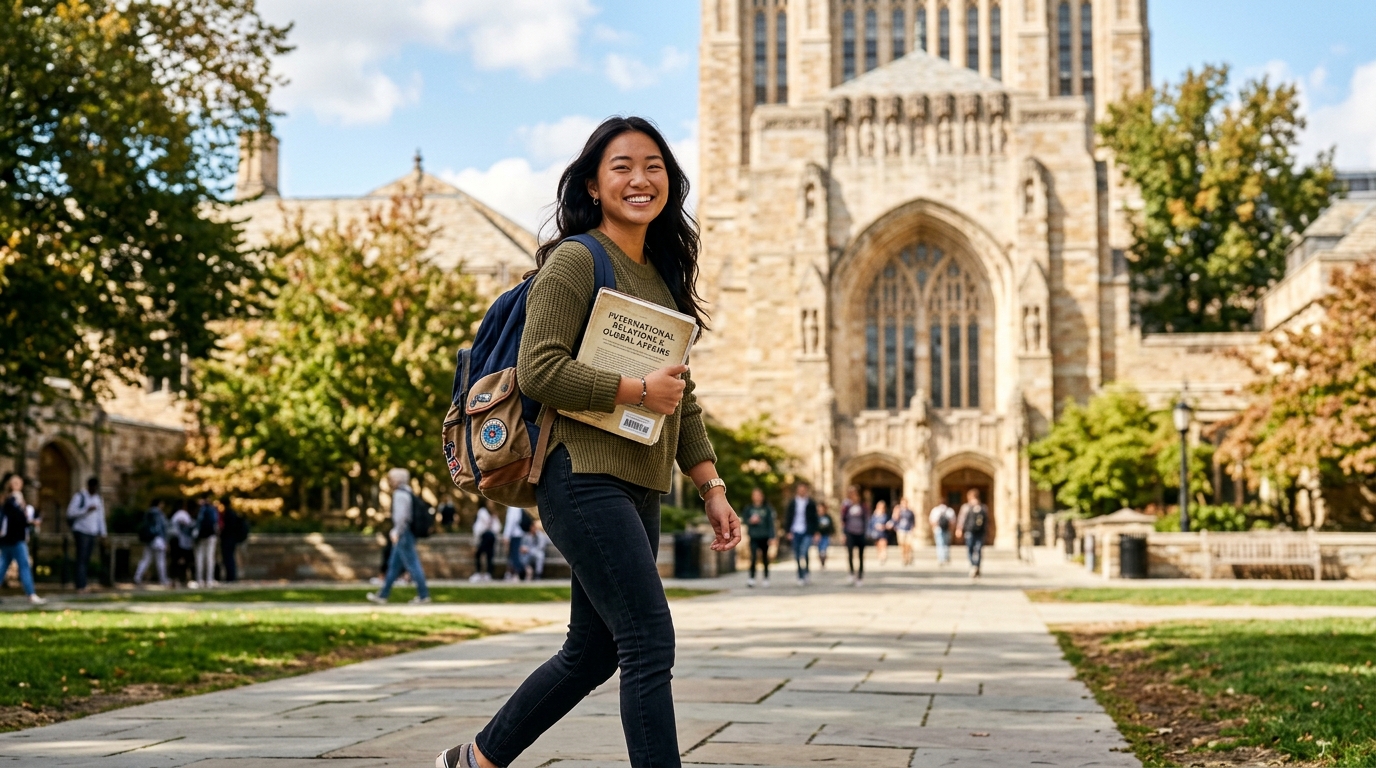
Financing a degree at an accredited United States university as an F-1, J-1, or M-1 visa holder requires navigating a completely different underwriting system than domestic students use. Because temporary visa holders are statutorily excluded from the Free Application for Federal Student Aid (FAFSA), international students must combine institutional merit scholarships, graduate assistantships, family funds, and private education loans structured either around a creditworthy U.S. co-signer or a specialized no-cosigner underwriting model.
This guide breaks down the exact underwriting criteria, Truth in Lending Act (TILA) statutory protections, in-school interest capitalization mathematics, and post-graduation OPT/H-1B refinancing rules you must verify before signing a promissory note.
1. Federal Student Aid (FAFSA) Rules: Non-Immigrant Visas vs. Eligible Non-Citizens
Under Title IV of the Higher Education Act, U.S. federal student loans (Direct Subsidized, Direct Unsubsidized, and Direct PLUS Loans) and Pell Grants are restricted to U.S. citizens, U.S. nationals, and specific categories of Eligible Non-Citizens verified through the Department of Homeland Security (DHS) SAVE system:
- Eligible for FAFSA (Federal Aid): Lawful Permanent Residents holding Form I-551 (Green Card), conditional permanent residents (I-551C), refugees and approved asylees under INA §§ 207–208, Cuban-Haitian Entrants, T-visa holders, and specific humanitarian parolees holding an arrival/departure record (Form I-94) stamped with qualifying statutory endorsements for at least one year.
- Ineligible for FAFSA (Private & Institutional Aid Only): Academic students on F-1 or F-2 visas, exchange visitors on J-1 or J-2 visas, vocational students on M-1 visas, diplomatic dependents (A/G visas), DACA recipients, Temporary Protected Status (TPS) holders, and applicants with pending asylum or adjustment-of-status petitions.
Before evaluating any private student loan, verify your institutional aid package with your university’s international financial aid office and review the official Federal Student Aid Non-U.S. Citizen Eligibility Requirements. Grants, tuition waivers, and graduate research or teaching assistantships (RA/TA stipends) do not accrue interest and should always be exhausted first.
2. Co-Signer vs. No-Cosigner International Student Loans: 2026 Underwriting Matrix
Private education lenders in the United States divide international applicants into two distinct underwriting tracks. Traditional national banks and credit unions underwrite the U.S. credit file and debt-to-income ratio of a U.S. co-signer, whereas specialized international student lenders evaluate the university’s graduation outcomes, degree field (such as STEM, business, health sciences, or law), and projected post-graduation earning potential without requiring a U.S. co-signer or Social Security Number (SSN) at application.
| Underwriting Criterion | Private Loan WITH a U.S. Co-Signer | No-Cosigner / No-SSN International Loan |
|---|---|---|
| Student Visa & Tax ID Requirements | Valid F-1, J-1, H-1B, DACA, TPS, or pending status; unexpired passport + Form I-20 / DS-2019 (SSN optional if co-signer has SSN) | Valid F-1, J-1, DACA, TPS, refugee, or asylum-pending status; no U.S. SSN or U.S. FICO score required to apply |
| Co-Signer Qualification Rules | U.S. Citizen or Lawful Permanent Resident (Form I-551) with 670–720+ FICO score, 2+ years of U.S. credit history, verifiable U.S. income, and DTI ratio below 35%–40% | None required. Student acts as sole obligor underwritten on academic standing, school tier, and future cash-flow model |
| Typical Fixed APR Range (2026) | 4.99% – 13.95% Fixed APR (includes 0.25% automated ACH payment discount; depends on co-signer FICO tier) | 9.99% – 16.99% Fixed APR (rate discounts of 0.25%–1.50% available for autopay, on-time payments, and graduation proof) |
| Origination & Administrative Fees | 0.00% origination fee across most bank and credit union student loan contracts | 0.00% – 5.00% origination/administration fee (often added to funded principal or deducted per disbursement; verify TILA box) |
| Annual & Aggregate Borrowing Caps | Up to 100% of School-Certified Cost of Attendance (COA) minus other aid ($150,000–$250,000 lifetime aggregate limit) | $2,001 to $50,000 per academic year ($100,000 lifetime cap; some lenders restrict funding to final 1–2 years of study or graduate programs) |
| Eligible Universities & Programs | 1,500+ Title IV-accredited 4-year public and private nonprofit U.S. universities | 400–500 pre-approved Title IV U.S. and Canadian research universities (heavily weighted toward STEM, MBA, engineering, and analytics) |
| In-School Payment Requirements | Flexible: Full in-school deferment, $25 fixed monthly payment, interest-only payment, or immediate full amortization | Often requires in-school interest-only payments or fixed monthly payments during study + 6-month post-graduation grace window |
| Co-Signer Release Eligibility | Contractually available after 12 to 48 consecutive on-time principal & interest payments once student obtains a U.S. SSN, OPT/H-1B income, and passes solo credit review | Not applicable (no co-signer is attached to the promissory note) |
For a focused comparison of joint legal liability and release clauses, read our dedicated guide on International Student Loans: Co-Signer vs. No-Co-Signer Paths.
Compare Pre-Qualified Education & Newcomer Financing Options (Soft Credit Pull)
Review fixed and variable APR disclosures, origination fee structures, and co-signer vs. no-SSN underwriting requirements across participating U.S. lending networks without impacting your credit score.
Explore Verified Loan Options →3. Empirical Amortization & Capitalization Math: How In-School Interest Multiplies Your Balance
The single most expensive mistake international borrowers make is ignoring interest capitalization. Under private student loan contracts, simple daily interest begins accruing the day funds are disbursed to your university bursar—computed as Daily Interest = Principal Balance × (Simple Interest Rate ÷ 365.25). If you select full in-school deferment (or pay less than the monthly accrued interest), all unpaid interest is added directly to your principal balance when your 6-month post-graduation grace period ends.
Once capitalized, you pay compound interest on top of that accrued interest for the entire 10-year (120-month) repayment schedule. Consider an empirical scenario where an F-1 graduate student borrows $30,000 at a 12.00% Fixed APR ($0 origination fee) with 24 months of enrollment plus a 6-month grace period (30 months before full amortization) and a 10-year (120-month) repayment term:
| In-School Repayment Option | Monthly Payment While in School (30 Mos.) | Unpaid Interest Capitalized at Month 30 | New Principal Entering Repayment | Post-Graduation Monthly Payment (120 Mos.) | Total Amount Repaid Over Loan Life | Total Interest Cost |
|---|---|---|---|---|---|---|
| Option A: Full In-School Deferment ($0/mo during school & grace) | $0.00 / mo | +$9,000.00 | $39,000.00 | $559.54 / mo | $67,144.80 | $37,144.80 |
| Option B: Fixed $25/Month Payment ($750 paid during school & grace) | $25.00 / mo | +$8,250.00 | $38,250.00 | $548.78 / mo | $66,603.60 | $36,603.60 (Saves $541.20) |
| Option C: In-School Interest-Only (Covers 100% of monthly accrual) | $300.00 / mo | $0.00 | $30,000.00 | $430.41 / mo | $60,649.20 | $30,649.20 (Saves $6,495.60) |
As the table demonstrates, paying $300/month in simple interest while enrolled prevents $9,000 from capitalizing at graduation, reducing your post-graduation monthly installment by $129.13/month and saving $6,495.60 in total interest. Run your own loan amount, APR, and in-school duration using our interactive International Student Loan Calculator, and read our breakdown of APR vs. Interest Rate for New Borrowers to see how upfront origination fees alter the effective APR.
4. Statutory TILA Timeline, School Certification & Required Documents
Unlike unsecured personal loans that deposit cash into a personal checking account within 48 hours, legitimate private student loans in the United States are governed by Truth in Lending Act (TILA) Regulation Z (12 CFR §§ 1026.46–1026.48) and require mandatory university certification before disbursement. Expect the complete funding cycle to take 3 to 6 weeks:
- Pre-Qualification & Application Disclosure: Submit an online pre-qualification check (typically a soft inquiry) to review estimated rate ranges. Once you submit a formal application (with or without a co-signer), the lender issues a statutory TILA Application Disclosure.
- Conditional Approval & 30-Day Rate Lock: Upon underwriting approval, the lender issues an Approval Disclosure. By federal law, the lender must hold your approved terms open for at least 30 calendar days so you can compare competing offers without pressure.
- Applicant Self-Certification & University Financial Aid Certification: You sign the standardized federal Private Education Loan Applicant Self-Certification Form, and the lender contacts your university’s financial aid office directly. The school verifies your enrollment status and certifies that the loan amount does not exceed your official Cost of Attendance (tuition, mandatory fees, room, board, health insurance, and books) minus scholarships.
- Final TILA Disclosure & 3-Business-Day Right to Cancel: After school certification, the lender issues a Final Disclosure. Under 12 CFR § 1026.48(d), no funds may be disbursed until a mandatory 3-business-day rescission period expires, during which you can cancel the loan in writing with zero penalty or fee.
- Direct Bursar Disbursement: Funds are wired directly to your university’s student account according to the academic semester schedule. Any approved living-expense credit balance is then refunded to your U.S. checking account by the university bursar.
Document Checklist for International Student Loan Applications
- Identity & Immigration Status: Unexpired foreign passport, SEVIS Form I-20 (for F-1 students) or Form DS-2019 (for J-1 scholars), and your electronic CBP Form I-94 arrival/departure record if already inside the United States.
- Academic & Cost Verification: Official university admission letter or current registrar transcript, financial aid award summary, and itemized institutional Cost of Attendance statement (many no-cosigner lenders issue conditional pre-approval letters you can use to satisfy SEVIS I-20 financial proof requirements before your visa interview).
- Residential Address Proof: Verifiable permanent home-country address plus your U.S. campus housing contract, utility bill, or off-campus lease.
- Co-Signer Documentation (If Applicable): Co-signer’s Social Security Number, unexpired U.S. driver’s license or state ID, U.S. passport or Form I-551 Green Card, last two years of IRS Form W-2 or Form 1040 tax returns, and two most recent pay stubs (see our Proof of Income Guide).
5. Honest Tradeoffs: Pros and Cons of Private International Student Financing
Key Advantages of Verified International Student Loans
- Bridges the Full Cost of Attendance Gap: Covers tuition, mandatory university health insurance, and living expenses up to the school-certified COA limit when scholarships and family savings fall short.
- Establishes Your U.S. Credit File Early: Participating lenders report on-time payments to Experian, Equifax, and TransUnion once your SSN or ITIN is linked, giving you a seasoned installment tradeline before graduation.
- Provides SEVIS I-20 / DS-2019 Financial Support Letters: Specialized no-cosigner lenders issue official sanction/support letters accepted by U.S. university DSOs and consular officers for F-1 visa issuance.
- Fixed APR Predictability & Zero Prepayment Penalties: Under federal law (15 U.S.C. § 1650(e)), private education lenders are strictly prohibited from charging any fee or penalty for early payoff or extra principal payments.
Critical Risks & Structural Limitations to Weigh
- Zero Federal Income-Driven Repayment (IDR) or Forgiveness: Private student loans never qualify for federal SAVE/IBR plans or Public Service Loan Forgiveness (PSLF). Hardship forbearance is discretionary and typically capped at 12–24 months total.
- High APRs on Unsecured No-Cosigner Contracts: Without a U.S. co-signer, fixed APRs frequently range between 11.00% and 16.99%, and some lenders add a 2%–5% origination fee to the principal balance.
- Co-Signer Legal Liability & Credit Exposure: A single 30-day late payment damages both the student’s and the U.S. co-signer’s credit reports, and the full loan balance counts toward the co-signer’s debt-to-income ratio when they apply for a mortgage or auto loan.
- Foreign Currency (FX) Repayment Risk: Because the debt is denominated in U.S. dollars (USD), returning to a home country with a depreciating local currency significantly increases the real repayment burden.
6. Post-Graduation Refinancing on OPT, STEM OPT & H-1B + Credit-Building Strategy
You are not locked into a high in-school interest rate forever. Because federal law prohibits prepayment penalties on student loans, international graduates who secure U.S. employment under 12-month post-completion Optional Practical Training (OPT), a 24-month STEM OPT extension, or an H-1B specialty occupation visa can refinance an expensive 12%–16% student loan into a lower-APR private refinance loan (often 6.00%–8.50% Fixed APR) once three underwriting milestones are met:
- Obtain Your Work-Authorized SSN or Valid ITIN: Apply for your Social Security Number as soon as your USCIS Employment Authorization Document (EAD, Form I-766) or on-campus employment letter is active. Review our comparison of ITIN vs. SSN Credit & IRS Notice CP565 Rules.
- Build 6 to 12 Months of Primary Revolving Credit History: Student loan refinance underwriters look for a 680+ U.S. FICO score and at least one primary revolving credit line with under 10% utilization. Open a $49 to $200 deposit secured credit card during your first semester and follow our U.S. Credit Score Guide so your FICO file is already 18–24 months old by graduation.
- Document Stable U.S. Salary & Visa Validity: Most refinance lenders require a written full-time U.S. job offer or 2–3 months of U.S. pay stubs, a debt-to-income ratio under 40%, and either a remaining OPT/STEM OPT window of 12+ months or an H-1B approval notice (Form I-797).
Start Building Your U.S. FICO Score While in School ($0 Annual Fee & Low Deposit Tiers)
Compare starter and secured credit cards that accept newcomers, students, and ITIN/SSN applicants, report to all three major U.S. credit bureaus, and prepare your credit profile for lower post-graduation loan refinancing rates.
Compare Newcomer Starter & Secured Cards →7. Frequently Asked Questions (FAQ)
Can an F-1 international student get a U.S. student loan without a Social Security Number (SSN) or co-signer?
Yes. Specialized private education lenders underwrite F-1 and J-1 international students without a U.S. co-signer or SSN by evaluating your university’s accreditation, degree program (especially graduate STEM, business, engineering, and healthcare tracks), academic transcripts, and projected post-graduation income. However, eligible school lists are stricter (typically 400–500 Title IV institutions) and fixed APRs are higher than co-signed bank loans.
Who can act as a co-signer for an international student loan in the United States?
A qualified co-signer must be a U.S. citizen or Lawful Permanent Resident (Green Card holder) aged 18 or older (19 in Alabama and Nebraska) who resides in the United States, maintains a FICO score of at least 670 to 700+, has a minimum of 2 years of established U.S. credit history, and demonstrates stable U.S.-sourced income with a debt-to-income ratio generally below 35%–40%. The co-signer does not need to be a blood relative.
Does paying an international student loan build a U.S. credit score?
Yes. Major U.S. private student lenders report loan balances and monthly payment performance to Experian, Equifax, and TransUnion. If you apply without an SSN initially, you should update your loan servicer profile as soon as you receive an SSN (through on-campus work, CPT, or OPT) so the credit bureaus accurately merge your positive payment history into your main FICO file.
Can I pay off an international student loan early without a prepayment penalty?
Yes. Under federal law—specifically Section 1011 of the Higher Education Opportunity Act (15 U.S.C. § 1650(e))—it is illegal for any private education lender in the United States to charge a fee or penalty for early repayment, lump-sum principal payments, or refinancing of a student loan.
What happens if my visa is denied or I cancel the loan before classes start?
Under TILA Regulation Z, you have an unconditional 3-business-day right to cancel a private education loan after receiving the Final Disclosure before any money is disbursed. Because funds are sent directly to your university bursar at the start of the semester, if your F-1 visa is denied prior to enrollment, the disbursement is canceled or returned by the university financial aid office without early termination penalties.
Federal Credit Disclosures, APR Ranges & Consumer Protection
Under federal lending regulations (Truth in Lending Act, 15 U.S.C. § 1601 et seq., and the Credit CARD Act of 2009), all credit issuers must disclose key borrowing terms, annual percentage rates, and fee structures in writing prior to account opening.
Short-term high-interest debt products (such as payday loans with 300%–600%+ effective APR, car title loans, and pawn loans) present severe risks of prolonged debt cycles for newcomers.
Fraud Alert: Legitimate U.S. credit card issuers and banks NEVER demand advance fees via gift cards, wire transfers (MoneyGram/Western Union), or cryptocurrency before approving or releasing credit. Report suspected lending scams to the Consumer Financial Protection Bureau (CFPB) at consumerfinance.gov.