
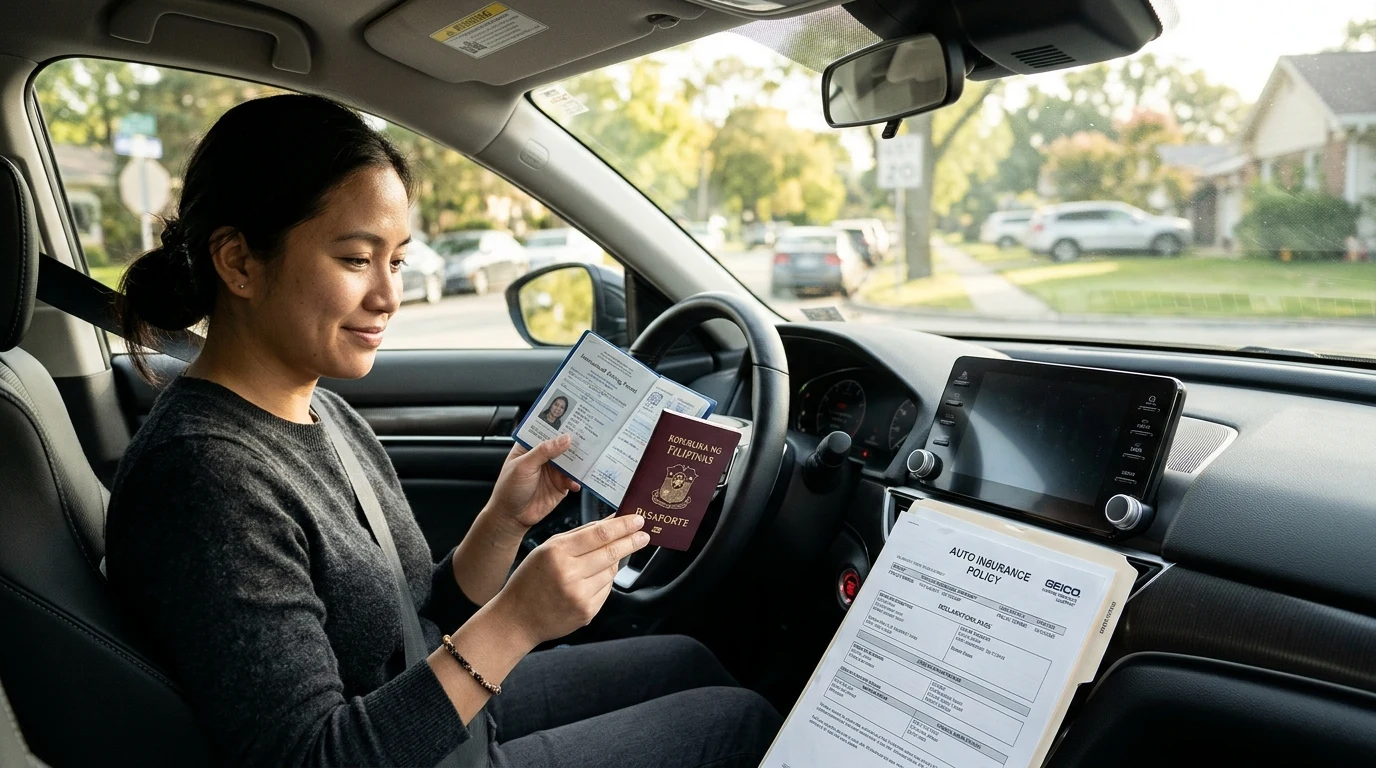
Securing a legally compliant auto insurance policy before driving a newly purchased or leased vehicle off the lot is one of the most expensive hurdles for recent arrivals in the United States. Because U.S. auto insurers rely heavily on two domestic databases that newcomers lack—a 3-to-5-year U.S. Motor Vehicle Record (MVR) from a state Department of Motor Vehicles and a domestic credit-based insurance score (used in 46 states)—automated online quote forms frequently assign foreign-licensed drivers to high-risk “inexperienced operator” tiers or reject the application outright when a state driver’s license number is missing.
This 2026 underwriting guide explains how U.S. auto insurance carriers evaluate drivers holding a foreign license or an International Driving Permit (IDP), compares the surcharge structures and state conversion deadlines across major jurisdictions, and outlines how to satisfy auto loan lienholder deductible rules when financing a vehicle with an ITIN or work visa. Before visiting the DMV, review our state-by-state U.S. driver’s license guide for newcomers and our manual on ITIN personal loans and auto financing for new immigrants.
1. Can You Buy U.S. Car Insurance With a Foreign Driver’s License?
Yes. Every U.S. state requires motor vehicle liability insurance before a car can be registered or driven on public roads, and state insurance codes permit licensed carriers to bind coverage using an unexpired foreign driver’s license, a foreign passport, or an International Driving Permit (1949 Geneva Convention or 1968 Vienna Convention format). However, carriers divide foreign-licensed applicants into three distinct underwriting categories based on licence origin and residency timeline:
- Canadian and U.S. Territory Licenses: Most national U.S. carriers connect directly to Canadian provincial motor vehicle abstract systems (such as Ontario MTO or British Columbia ICBC). If you present a clean 3-year Canadian driving abstract and claims-experience letter, underwriters frequently credit your full driving tenure without applying a zero-experience surcharge.
- Non-Canadian Foreign Licenses With Verifiable Claims Letters: Select national and regional carriers accept an official English-translated no-claims certificate from your home-country insurer, reducing the “unverifiable driving record” surcharge during your first 6-month policy term.
- Foreign License + IDP Pending State DMV Conversion: Mainstream carriers will bind a 6-month policy on a foreign license on condition that the named insured obtains a state-issued driver’s license within 30 to 90 days of policy inception (or maintains an active DMV road-test appointment receipt).
2. 2026 Underwriting Matrix: How Carriers Rate Foreign Licenses
Standard online quote engines often require a formatted state license number to pass field validation. When insuring a vehicle with a foreign credential, calling a licensed agent or using a carrier’s non-standard underwriting desk prevents automatic rejections and ensures your foreign driving tenure is properly coded.
| Carrier Category | Accepts Foreign License at Binding | State License Conversion Window | Typical Unverifiable MVR Surcharge | Accepts ITIN / Passport for Billing |
|---|---|---|---|---|
| National Direct Carriers (Major Multi-State Insurers) | Yes (phone or agent bind for non-U.S. numbers) | 30 to 60 days from policy effective date | +18% to +35% until state license is issued | Yes (EFT bank draft or starter credit card) |
| Regional Non-Standard & Specialty Insurers | Yes (accepts foreign license, IDP, and Matrícula Consular) | No mandatory conversion on 6-month term | +25% to +45% base rate; lower down payment | Yes (ITIN, passport, and cash/debit options) |
| State Assigned-Risk Automobile Plans (AIPSO) | Yes (statutory insurer of last resort) | Follows state residency statute (30–90 days) | State-regulated tariff (+30% to +50%) | Yes (guaranteed issue with valid registration) |
| Pay-Per-Mile & Telematics Insurers | Select states (requires smartphone OBD/app tracking) | 60 days in most participating states | Base rate + $0.05–$0.09 per driven mile | Yes (requires U.S. debit or credit card on file) |
Compare U.S. Auto Insurance Quotes for Foreign-Licensed & Newcomer Drivers
Check state-compliant liability, collision, and comprehensive rates across licensed U.S. auto insurers that accept foreign driver licenses, international permits, and thin credit files.
Compare Auto Insurance Quotes →3. State Residency Deadlines and Credit-Based Insurance Score Rules
Where you settle in the United States determines both how long you can legally drive on a foreign license and whether your lack of a U.S. credit score increases your insurance premium:
- States Prohibiting Credit-Based Insurance Scoring (CA, HI, MA, MI): In California (Proposition 103), Hawaii, and Massachusetts, auto insurers are strictly prohibited by state law from using consumer credit scores to calculate auto insurance premiums. Michigan also bans the use of credit scores directly, though insurers may still use certain non-credit underwriting factors. For a newcomer with zero U.S. credit history, binding a policy in these states eliminates the “no-hit credit file” penalty that adds $400 to $900 per year in other states.
- State License Conversion Windows After Establishing Domicile: Tourists and temporary visitors can drive on a valid foreign license (paired with an IDP if the license is not in English) for the duration of their authorized stay. However, once you establish state residency—triggered by signing a residential apartment lease, accepting local employment, or enrolling children in public school—state statutes require you to convert to a local license within strict windows: 10 days in California, 30 days in New York, Florida, and Georgia, and 90 days in Texas and Illinois.
- Avoiding Unlicensed-Operator Claim Denials: If you allow your state conversion window to expire without obtaining a state learner’s permit or driver’s license and remain on a foreign license long after establishing domicile, a non-standard insurer may invoke an “unlicensed resident operator” exclusion during a disputed at-fault claim. Always upload your state learner’s permit or driver’s license to your insurer’s portal the day it is issued to lock in an immediate 12% to 25% re-tiering discount.
4. Satisfying Auto Loan Lienholder Deductible Rules With an ITIN
If you finance a car through a credit union, captive automaker program, or online lender, your loan contract requires you to carry full physical damage coverage—specifically Comprehensive (Other Than Collision) and Collision insurance—in addition to state minimum bodily injury and property damage liability:
- Maximum Deductible Caps ($500 to $1,000): Almost all U.S. auto loan lienholders reject insurance binders that carry a $1,500 or $2,000 collision deductible. Verify that both your comprehensive and collision deductibles are set to $500 or $1,000 before asking the insurance agent to fax or email the Declarations Page and Loss Payee binder to the lender.
- Avoiding Force-Placed (Collateral Protection) Insurance: If your policy lapses for non-payment or if you fail to add the lender’s exact legal Loss Payee address within 14 days of loan funding, the lender will purchase Collateral Protection Insurance (CPI) and add $150 to $350 per month directly to your auto loan payment. Critically, CPI covers only the lender’s loan balance—it provides zero liability coverage for you and does not satisfy state DMV financial responsibility laws.
- Pairing Auto Insurance Payments With Credit Building: Rather than paying your monthly premium with a debit card or money order, set up autopay on one of our starter credit cards for newcomers without an SSN and pay the statement balance in full every month to generate positive on-time payment history across all three bureaus.
Compare Pre-Qualified U.S. Auto Financing & Refinance Rates
Review transparent APR ranges, down-payment requirements, and monthly payment terms from U.S. auto lenders and credit unions that work with ITIN holders and new arrivals.
Compare Auto Loan Options →5. How to Cut Your First-Year U.S. Auto Insurance Premium by 25%–40%
Newcomers do not need to stay stuck in high-risk non-standard tiers for a full year. Execute these four steps during your first 180 days in the United States to bring your premium down to standard domestic rates:
- Enroll in Telematics / Usage-Based Monitoring (Day 1): Opting into a carrier’s smartphone or plug-in OBD-II safe-driving program grants an immediate 5% to 10% participation discount at binding and up to 20%–30% at your 6-month renewal based on smooth braking, daytime driving, and low mileage.
- Complete a State-Approved Defensive Driving Course (Month 1): In states such as New York, Texas, Florida, California, and New Jersey, completing a 6-hour online state-certified defensive driving class provides a mandatory 5% to 10% liability and collision discount valid for 3 years.
- Bundle Renters Insurance ($12–$18/Month): Adding an HO-4 renters insurance policy (which most U.S. apartment landlords require before handing over keys) triggers a multi-policy discount on your auto policy that often offsets 60% to 90% of the renters policy cost.
- Re-Shop Exactly at the 6-Month Mark: In the U.S. insurance market, reaching 6 months of continuous prior insurance coverage (with zero lapse days) and holding a valid state driver’s license moves you out of the high-risk unassigned pool and into standard preferred underwriting tiers.
Frequently Asked Questions
Does an International Driving Permit (IDP) lower U.S. car insurance rates on its own?
No. An International Driving Permit is strictly an official multi-language translation of your home-country driver’s license; it is not a standalone license and does not create a U.S. Motor Vehicle Record. However, presenting an IDP alongside a non-English foreign license is required by many state police departments and insurance compliance desks to verify your license class and issue date.
What happens if I let my car insurance lapse for even a few days in the United States?
Most U.S. states operate real-time electronic insurance verification systems linked directly to the DMV. A coverage lapse of even 1 to 7 days triggers automatic vehicle registration suspension, civil reinstatement fines ($100 to $500+ in states like New York, Florida, and Virginia), and an SR-22 financial responsibility filing requirement, while resetting your 6-month continuous coverage clock with insurers.
Should I buy only state minimum liability coverage to save money as a newcomer?
State minimum liability limits—such as $15,000/$30,000/$5,000 or $25,000/$50,000/$25,000—are rarely sufficient to cover a modern multi-vehicle accident or emergency room bill, leaving your personal savings and wages exposed to civil judgments. Financial planners recommend carrying at least 100/300/100 ($100,000 per person bodily injury, $300,000 per accident bodily injury, and $100,000 property damage) plus Uninsured/Underinsured Motorist (UM/UIM) coverage.