
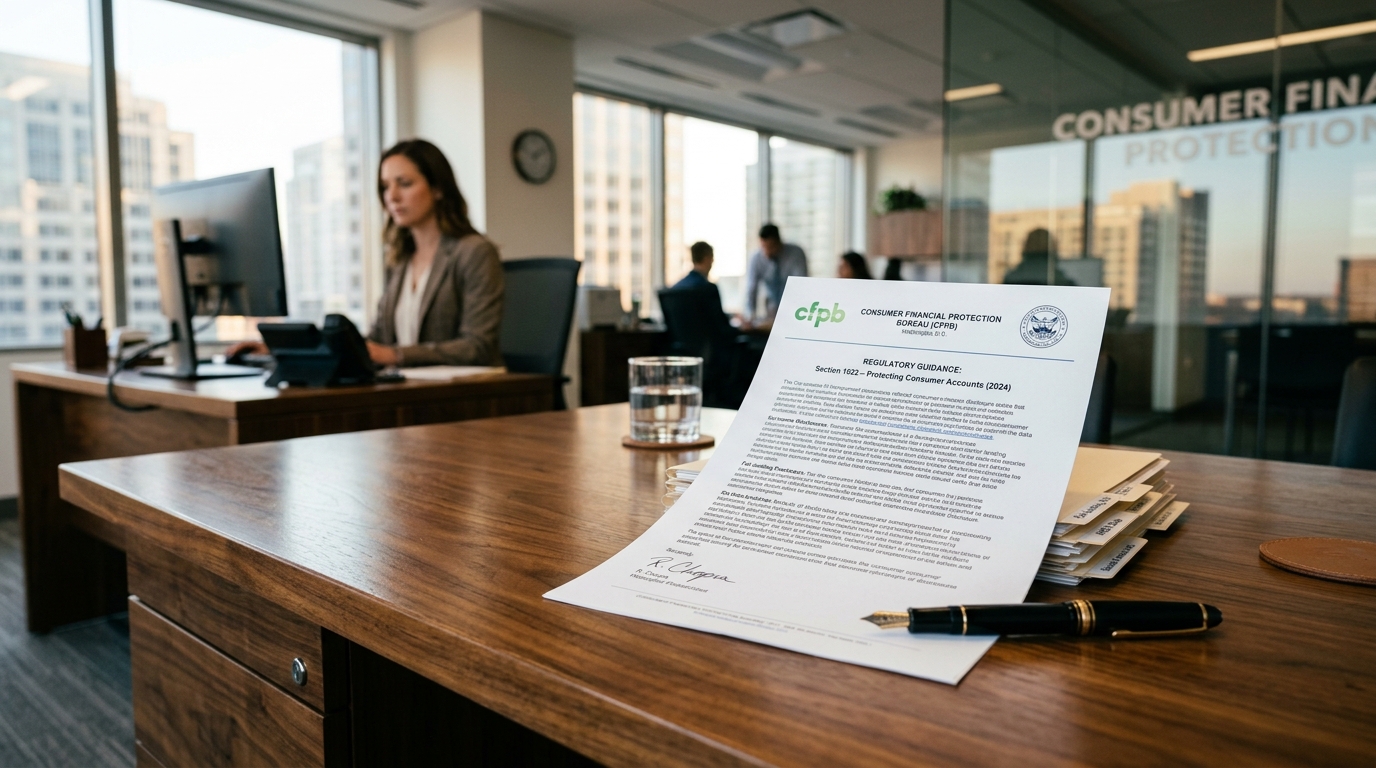
The Consumer Financial Protection Bureau (CFPB) has issued comprehensive supervisory highlights and an updated advisory bulletin clarifying fair lending enforcement standards under the Equal Credit Opportunity Act (ECOA) and Regulation B. The guidance explicitly addresses the widespread institutional practice of blanket account denials for applicants lacking a Social Security Number (SSN), establishing clear boundaries for retail depository institutions, fintech originators, and credit-builder platforms across the United States.
1. The Legal Framework: Section 326 of the USA PATRIOT Act vs. Bank Policy
For more than two decades, immigrant applicants, international students on F-1 visas, specialty workers on H-1B or L-1 permits, and humanitarian parolees (including U4U and TPS beneficiaries) have encountered arbitrary rejection at branch counters. Many national and regional commercial banks have historically insisted on a domestic SSN as a non-negotiable software validation requirement during digital and in-person onboarding.
The CFPB’s 2026 supervisory bulletin reiterates federal statutory requirements under 31 CFR § 1020.220 (implementing Section 326 of the USA PATRIOT Act):
- Federal Customer Identification Program (CIP) Minimums: Federal law requires financial institutions to collect four core data points: name, date of birth, residential street address, and an identification number.
- Authorized Non-SSN Identification: For non-U.S. persons, federal regulations permit banks to accept an Individual Taxpayer Identification Number (ITIN), an alien identification card number, or an unexpired foreign government passport accompanied by a valid visa or Form I-94 arrival/departure record.
- Prohibition on Unjustified Blanket Exclusions: While depository institutions maintain discretion over risk-based underwriting, adopting blanket categorical bans against non-permanent residents without empirical credit risk justification exposes institutions to regulatory scrutiny under ECOA fair lending doctrines.
2. Section 1071 Small Business Lending Data Implementation
Simultaneously, the CFPB is rolling out tiered compliance deadlines for Section 1071 of the Dodd-Frank Act. Section 1071 mandates that covered financial institutions compile and report comprehensive application data on credit extended to small businesses, minority-owned enterprises, and immigrant entrepreneurs.
Under the revised compliance schedule, highest-volume lenders (originating 2,500 or more covered small business credit transactions annually) must begin mandatory data logging on October 1, 2026. This regulatory shift creates profound structural incentives for national lenders to formalize transparent underwriting criteria for ITIN-based sole proprietorships and foreign-owned LLCs.
Compare Verified Newcomer Accounts Without SSN
Review audited banking platforms and secured credit builders accepting ITIN, foreign passports, and international student documentation with zero impact on your file.
3. What Immigrants and Foreign Professionals Must Know Before Applying
Despite federal regulatory clarity, operational execution at local bank branches frequently lags statutory guidance. Financial compliance analysts at CreditForNewcomers recommend the following structured protocol when opening initial deposit and credit accounts:
- Request In-Branch Foreign National CIP Onboarding: At institutions such as Bank of America or JPMorgan Chase, inform the branch relationship banker that account opening will proceed under the non-resident Customer Identification Program using an unexpired foreign passport and secondary identification.
- Maintain Form W-8BEN Preparedness: Non-resident aliens should carry executed or blank Form W-8BEN (Certificate of Foreign Status of Beneficial Owner for United States Tax Withholding) to establish exemption from domestic backup withholding on interest income.
- Document Domestic Physical Address: Financial institutions are legally barred from accepting commercial mail receiving agency (CMRA) addresses or P.O. boxes as primary CIP addresses. Secure a residential utility bill, signed lease agreement, or official university housing letter before presenting applications.
4. Regulatory Enforcement Outlook for 2026 and 2027
The CFPB confirmed that joint supervisory examinations with the Office of the Comptroller of the Currency (OCC) and the Federal Deposit Insurance Corporation (FDIC) will actively review bank automated denial algorithms. Fintech platforms utilizing artificial intelligence models that automatically reject applications upon null SSN inputs will face administrative remediation orders.
For international newcomers navigating the early stages of domestic financial integration, the regulatory trajectory provides significant legal clarity: an SSN is not a statutory prerequisite to initiate banking relationships or build empirical credit in the United States.
Federal Credit Disclosures, APR Ranges & Consumer Protection
Under federal lending regulations (Truth in Lending Act, 15 U.S.C. § 1601 et seq., and the Credit CARD Act of 2009), all credit issuers must disclose key borrowing terms, annual percentage rates, and fee structures in writing prior to account opening.
Short-term high-interest debt products (such as payday loans with 300%–600%+ effective APR, car title loans, and pawn loans) present severe risks of prolonged debt cycles for newcomers.
Fraud Alert: Legitimate U.S. credit card issuers and banks NEVER demand advance fees via gift cards, wire transfers (MoneyGram/Western Union), or cryptocurrency before approving or releasing credit. Report suspected lending scams to the Consumer Financial Protection Bureau (CFPB) at consumerfinance.gov.