

Compare renters insurance
Many landlords ask tenants for renters insurance. SuperMoney compares policies that cover your belongings and liability.
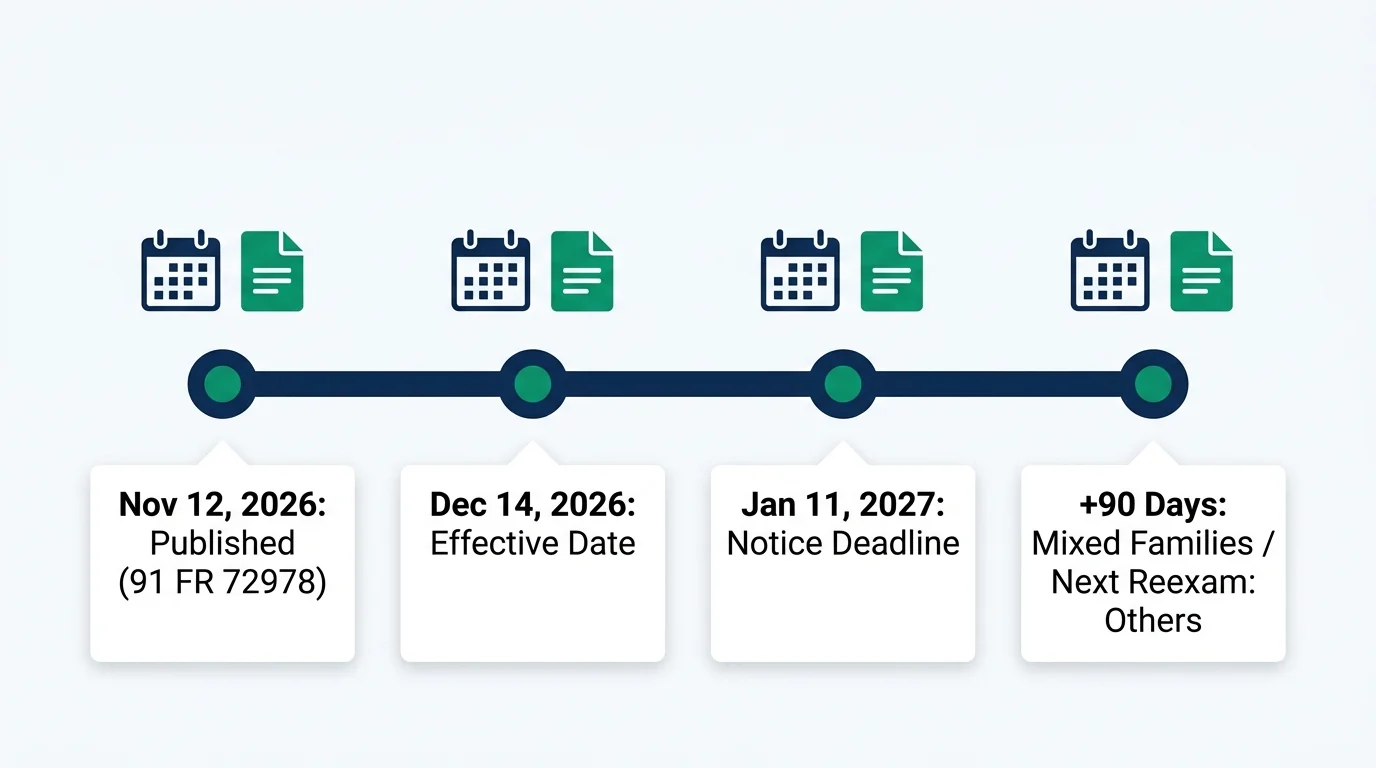
Compare renters insurance →Short answer: On November 12, 2026, HUD published a final rule (91 FR 72978) taking effect December 14, 2026 that requires verification of U.S. citizenship or eligible immigration status for every household member regardless of age in covered programs, including Public Housing and Section 8 vouchers. The rule eliminates age exemptions and the “do not contend” opt-out election, directs housing providers to notify unverified tenants by January 11, 2027, requires existing unverified mixed families to submit evidence within 90 days of December 14, 2026, and converts prorated assistance into a temporary status while verification is pending.
Although housing regulation sits outside credit cards and personal banking, many newcomer and mixed-status households rely on HUD-assisted rent programs while building financial stability. Below is exactly what the Federal Register final rule (2026-23003 / 91 FR 72978) changes on December 14, 2026, which programs it covers, and what deadlines and hearing rights apply.
Which HUD housing programs are covered
Issued under Section 214 of the Housing and Community Development Act of 1980 (42 U.S.C. 1436a) and amending 24 CFR Part 5 (Subparts B and E), the final rule applies to Public Housing Agencies (PHAs) and participating project owners across four covered program categories listed in 24 CFR § 5.500(a):
- Public Housing programs under the United States Housing Act of 1937
- Section 8 rental assistance programs, including Housing Choice Vouchers, Project-Based Vouchers, Project-Based Rental Assistance, and Moderate Rehabilitation
- Housing Development Grant programs (low-income units only)
- Section 236 of the National Housing Act (tenants paying below-market rent only)
Private unsubsidized apartments, market-rate leases, and programs outside Section 214 (such as Low-Income Housing Tax Credit properties without overlapping Section 8 project-based subsidies) are not governed by this 24 CFR Part 5 rule.
Four key rule changes taking effect December 14, 2026
| Rule provision | Prior regulation | Final rule (effective December 14, 2026) |
|---|---|---|
| Age threshold (§ 5.508(b)) | Certain procedures and documentation rules differed by age, including exceptions for individuals 62 or older. | All household members—including minor children and seniors aged 62+—must undergo verification. |
| “Do not contend” option (§ 5.508) | Household members could decline to contend eligible immigration status and remain in mixed-family households without documenting status. | The “do not contend” opt-out election is eliminated; every household member must submit a declaration and verification consent. |
| U.S. citizenship verification (§ 5.508(b)(1) & § 5.512) | Signed citizenship declaration generally sufficed without universal SAVE screening. | Citizens must provide a signed declaration, complete and accurate Social Security Number, and signed consent for primary verification in DHS SAVE; if SAVE cannot confirm, acceptable citizenship documents are required within 30 days. |
| Prorated assistance (§ 5.506 & § 5.520) | Mixed-status families could receive prorated assistance indefinitely. | Prorated assistance becomes a temporary condition strictly while verification (including secondary checks or hearings) is pending, outside narrow statutory preservation provisions (§ 5.516 / § 5.518). |
Exact deadlines for applicants and existing tenants
Unlike a typical sudden cut-off, 24 CFR § 5.508(e) and (f) establish distinct compliance dates depending on your household category:
- New applicants on or after December 14, 2026: Notification is given at application, and verification generally must occur before assistance starts unless a PHA elects pre-verification occupancy under § 5.512(b).
- Mandatory written notice from your PHA or landlord: Under § 5.508(e)(1)(ii), responsible entities must deliver written notice to every existing tenant lacking required evidence no later than January 11, 2027.
- Existing unverified mixed families: Under § 5.508(f)(2)(i), mixed families in a covered program who have not yet submitted evidence as of December 14, 2026 must submit required evidence within 90 days of December 14, 2026.
- All other existing unverified tenants: Under § 5.508(f)(2)(ii), other unverified tenants must submit evidence at their next annual or interim reexamination of income and household composition after December 14, 2026.
Documents required for U.S. citizens vs. eligible noncitizens
Do not mail or surrender original identity papers permanently: § 5.510(a) requires the PHA or project owner to inspect originals or certified copies, make photocopies for their file (retained for at least 5 years under § 5.514(g)), and return the originals to the family.
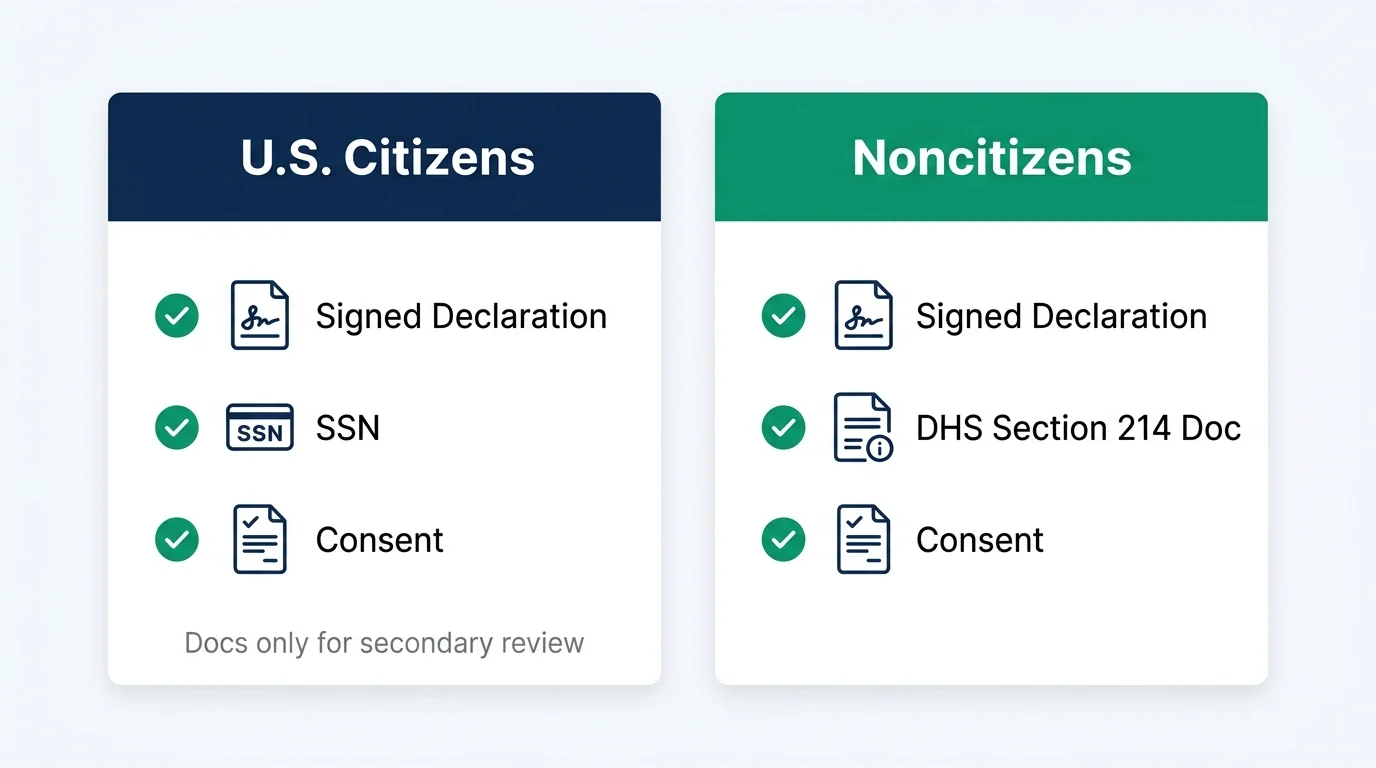
- For each U.S. citizen (including citizen children, signed by a responsible adult in the unit):
- Signed written declaration of U.S. citizenship under penalty of perjury (§ 5.508(c))
- Complete and accurate Social Security Number (§ 5.508(b)(1)(ii))
- Signed verification consent form authorizing HUD and DHS SAVE verification (§ 5.508(d))
- If secondary verification is triggered because SAVE cannot confirm citizenship (§ 5.512(d)(2)): original or certified copy of a U.S. birth certificate, naturalization certificate, Consular Report of Birth Abroad (FS-240), valid unexpired U.S. passport, certificate of citizenship, or other HUD-specified document within 30 days of the secondary verification notice.
- For each noncitizen claiming eligible status under 42 U.S.C. 1436a(a):
- Signed declaration of eligible immigration status under penalty of perjury (§ 5.508(c))
- Original or certified DHS-designated acceptable immigration document proving an eligible category under Section 214 (§ 5.510(c))
- Signed verification consent form allowing SAVE checks (§ 5.508(d))
Extensions, record corrections, and informal hearing rights
If a birth certificate, passport, or DHS record is delayed or contains an error, the final rule retains explicit procedural protections:
- 60-day good-cause extension (§ 5.508(g)): If you submit the signed declaration and consent form and certify that supporting evidence is temporarily unavailable despite prompt and diligent efforts, the PHA or owner must grant a written extension of up to 60 days.
- Records correction right (§ 5.512(d)(1)(iv)): Notices must inform you of your right at any point in verification to pursue a record correction with the agency that issued or holds the record (for example, SSA, DHS, or a state vital records office).
- 30-day informal hearing deadline (§ 5.514(e)): If assistance is proposed for denial or termination, you have 30 days from receiving the written notice to request an informal hearing and present evidence.
- Narrow legacy preservation assistance (§ 5.516 / § 5.518): Continued prorated assistance without termination applies narrowly under statutory criteria primarily to families continuously assisted since June 19, 1995 where the head of household or spouse has eligible status; other mixed families may only receive discretionary temporary deferral of termination in qualifying circumstances.
Where to verify status or get free legal help
Before taking any action based on social-media rumors—and before leaving an assisted apartment voluntarily—wait for the official written notice from your PHA or property owner, confirm whether every household member already has an SSN or birth record on file, and seek local legal assistance if needed:
- Find free local civil legal aid at LawHelp.org or dial 211 for local tenant counseling.
- If you eventually transition to a private market lease while building your financial profile, review our first 100 days U.S. financial setup checklist and Rent Affordability Calculator.
Frequently asked questions
When does the HUD Section 214 verification rule take effect?
The final rule (91 FR 72978) was published November 12, 2026 and takes effect December 14, 2026. Housing providers must send written notices to unverified tenants no later than January 11, 2027.
Do U.S. citizen children in assisted housing need to submit documents immediately?
An adult in the unit must sign a declaration and verification consent form for each child and provide the child’s SSN. A physical birth certificate or U.S. passport is only required within 30 days if primary DHS SAVE verification cannot confirm citizenship and triggers secondary verification.
How long do existing mixed-status families have to submit evidence?
Under 24 CFR § 5.508(f)(2)(i), mixed families receiving covered assistance who have not submitted evidence as of December 14, 2026 must submit it within 90 days of December 14, 2026, subject to an up-to-60-day extension for diligent efforts when documents are temporarily unavailable.
Does this rule apply to private unsubsidized rentals?
No. It applies only to HUD Section 214 covered programs: Public Housing, Section 8 programs, Housing Development Grant low-income units, and Section 236 below-market-rent units.
Sources checked November 18, 2026
- Federal Register (HUD Final Rule): Housing and Community Development Act of 1980: Verification of Eligible Status (91 FR 72978, Docket FR-6524-F-02, RIN 2501-AE16, November 12, 2026)
- HUD Press Release: HUD No. 26-091 (November 10, 2026)
- U.S. Code (Section 214): 42 U.S.C. § 1436a — Restrictions on use of assisted housing by non-resident aliens