Your first 90 days in the U.S.: a practical money checklist

The first 90 days in the United States are easier if you treat money tasks as a sequence: documents, a bank account, then one first credit card. This checklist is for newcomers and new immigrants who need a practical first credit card in USA checklist, not a promise that a score will appear overnight.
Days 1–14: lock down documents and a U.S. address
Keep your passport, visa, I-94, green card or EAD, Social Security card or ITIN letter, and lease in a safe place. Photograph them only into a device you control. A physical U.S. residential address is required for most bank and card applications. Update the address with USPS and with any employer or school that will send tax forms.
- Write down which institutions accept an SSN, an ITIN, or a passport-only branch visit.
- Turn on unique passwords and multifactor authentication for email and banking.
- Do not send identity scans through an unverified chat, social ad, or comparison form.
Days 7–30: open a U.S. bank account
A checking account is the usual funding path for a first card. Compare monthly fees, ATM access, incoming-wire cost, and deposit insurance. Read how to open a U.S. bank account as a newcomer before you visit a branch. Direct deposit, if you have a job, can later help some issuers evaluate you, but it is not a substitute for a credit file.
First credit card in USA checklist
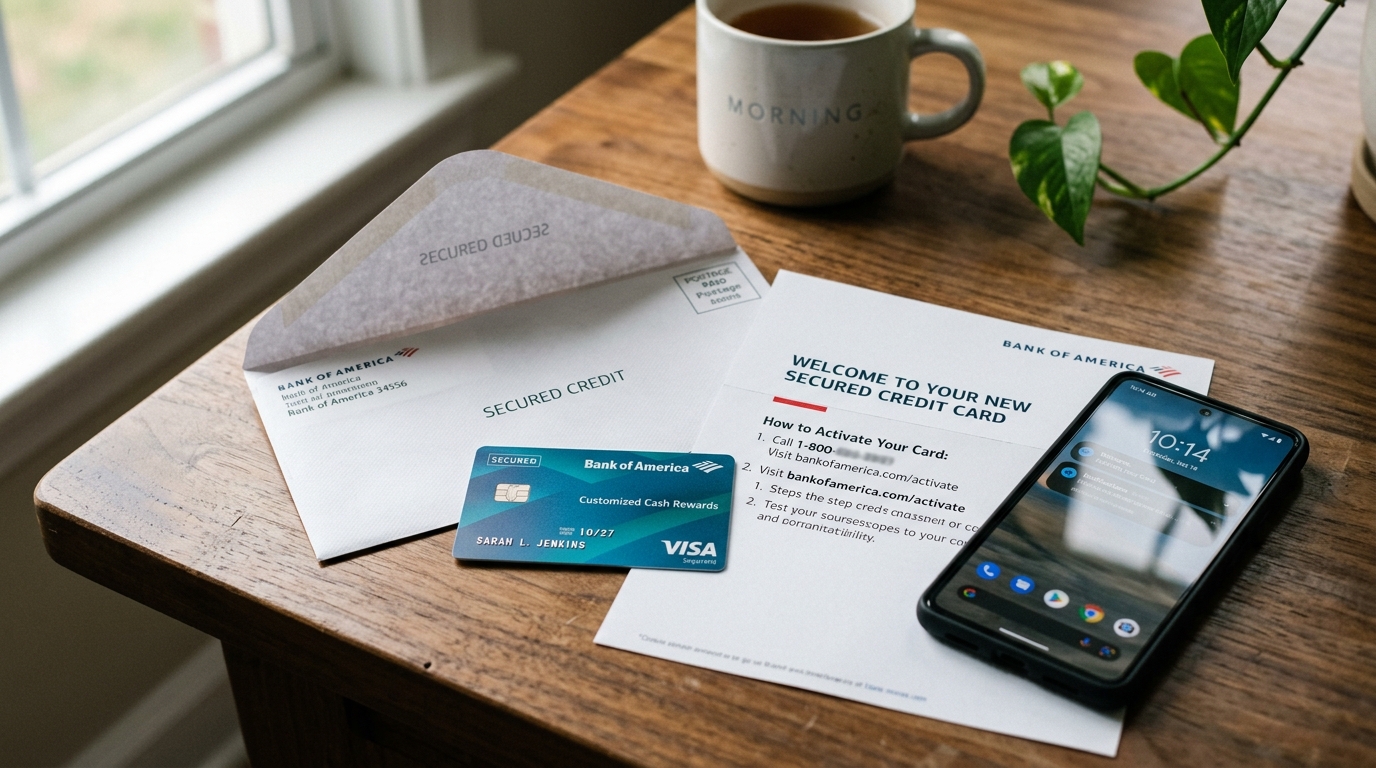
Use this first credit card in USA checklist once the bank account exists. One well-understood starter card beats three rushed applications.
- Decide the product type. Secured cards use a refundable deposit. Some student or alternative-underwriting cards do not. Subprime unsecured cards with monthly program fees are usually a poor first choice.
- Confirm identification. Ask the issuer whether it accepts your SSN, ITIN, or a branch passport package. Green card holders with an SSN can often apply online; a thin file may still mean a secured card.
- List the fees. Annual fee, foreign-transaction fee, late fee, deposit amount, and any cash-advance APR belong on one page before you click apply.
- Check the inquiry type. Pre-qualification is often a soft pull. The full application may be a hard pull. Ask before you submit.
- Confirm bureau reporting. A starter card only helps a U.S. file if the issuer reports to Experian, Equifax, and/or TransUnion.
- Apply once. Wait for the decision. Do not stack applications the same weekend.
- Set autopay and alerts. Pay at least the minimum automatically, then pay the statement balance if you can.
- Keep the first purchase small. A grocery or transit charge you can repay is enough to start a payment history.
Compare product types on our credit cards for newcomers page and the secured-card guide. Those pages explain deposits and graduation. They do not guarantee that any named issuer will approve you.
Days 30–60: use the card as a bill, not extra cash
Utilization is the share of your limit that appears as a balance. A $150 balance on a $300 secured limit is 50%. Many newcomers overspend a small limit by accident. Keep the reported balance low relative to the limit and review how utilization is calculated.
If the card has a foreign-transaction fee, use a debit card or a no-fee method for spending in another currency. Do not take cash advances to send remittances; those APRs and fees are usually the most expensive part of a card.
Days 60–90: monitor, do not “hack” the score
When a file exists, pull official reports at AnnualCreditReport.com. Check the name, address, account status, and that the card is reporting. Dispute errors with the bureau and the furnisher. Ignore anyone who sells a guaranteed 700 score or a paid wipe of accurate history.
- One on-time payment cycle is useful. Six on-time cycles are more useful.
- Do not close the first card immediately after a second card is approved; age of accounts can matter later.
- Keep copies of the card agreement, deposit receipt, and statements.
If the first card is declined
A decline is common on a brand-new file. Read the adverse-action notice if one arrives. Typical reasons include no U.S. credit file, an address that does not match, or a product that requires an SSN you do not have yet. Do not immediately apply at three other issuers. Fix the document or product type, wait, then apply once more.
If you have no SSN, use the ITIN or in-branch passport path only when the issuer documents it. If you have an SSN and a green card but no file, a secured card with a deposit you can afford is usually the next experiment—not a high-fee unsecured card sold as “guaranteed.”
A simple 90-day calendar
- Week 1: documents, address, password hygiene.
- Week 2: bank account open, debit card in hand.
- Week 3–4: one starter-card application using the checklist above.
- Week 5–8: small on-time purchases, statement paid, utilization watched.
- Week 9–12: official credit reports, error check, no extra applications unless a decline forced a documented retry.
Fees and scams to stop for in the first 90 days
Advance-fee loan texts, “guaranteed approval” cards, and requests for gift cards or remote-access codes are warning signs. A legitimate issuer discloses fees in writing and does not need your online-banking password to open a starter card.
This 90-day money checklist is general education for U.S. newcomers. It is not legal, immigration, or financial advice. Product rules change; confirm them on the provider’s site before you apply.
Recommended Financial Tools for U.S. Newcomers
Compare verified loan options and track your credit standing without hidden fees or surprise charges.
Fast Personal Loan & Cash Matching
Connect with established direct lenders offering flexible terms and clear disclosures.
- ⚡ Borrow $500 – $50,000 with transparent APR
- ⚡ Fast online decision & direct deposit to your U.S. bank
- ⚡ Check pre-approval options without obligation
3-Bureau Credit Reports & ID Protection
Monitor your credit across Experian, Equifax, and TransUnion with 24/7 identity theft protection.
- 🛡️ Real-time 3-bureau credit reports and score alerts
- 🛡️ Dark web monitoring & SSN fraud detection
- 🛡️ Up to $1,000,000 identity theft insurance coverage
Advertiser Disclosure: We may receive compensation from partner links at no cost to you. This does not influence our independent editorial research.